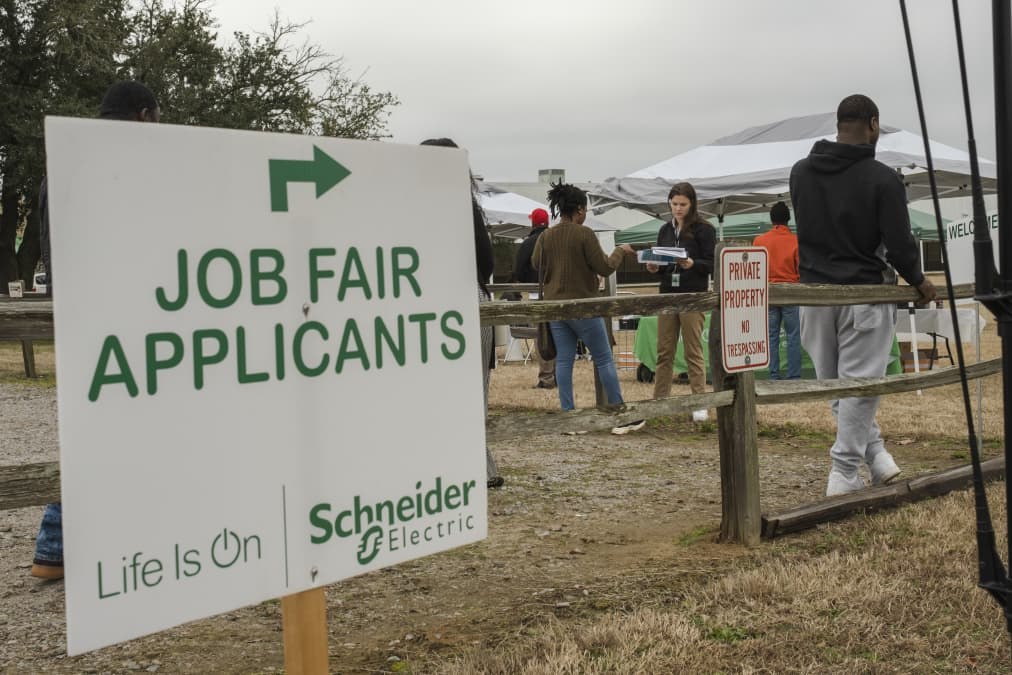
The world of economic development is spinning fast in 2026. Companies are pressing some specific demands of the states they are willing to do business in.
They want low costs, minimal red tape, and turnkey sites that afford them the greatest speed to market. They want cheap and reliable electricity and abundant water in a stable economy.
But none of it means a thing without people.
"Talent is always the No. 1 site selection criterion," said Larry Gigerich, executive managing director of Ginovus in Indianapolis, and chairman of the Site Selectors Guild.
Worker shortages nationwide have eased considerably from their alarming levels in the years following the pandemic, when there were millions more job openings than there were workers to fill them. Today, more people have returned to work, and productivity tools like AI are taking up some slack. But that is not to say there isn't still a skills gap.
"There is still an availability and a quality mismatch," Gigerich said.
That explains why states are aggressively pitching their talent pools to business, and why Workforce remains one of the most important categories in CNBC's annual America's Top States for Business study—worth 13.8% of a state's total score under this year's methodology.
To gauge each state's workforce, we consider net migration of workers to each state, with an emphasis on college-educated employees. We consider the percentage of each state's workforce with college and advanced degrees, as well as the concentration of science, technology, engineering and math (STEM) employees. But we also look at each state's pipeline of students and graduates in career education.
"We're seeing more and more companies where certifications and industry-recognized credentials are becoming more valuable for certain types of jobs," Gigerich said.
We measure the success of state workforce training programs in getting their participants hired. We also award points for workforce productivity, and for right-to-work states where employees cannot be forced to join a union.
These states are attracting the best and the brightest.
Virginia
Virginia prides itself on being able to supply workers that fit employers' needs. The Virginia Talent Accelerator Program is a collaboration between the Virginia Economic Development Partnership and the state's community college system to provide job-specific training to prospective employees. Officials say the program has supported some 22,000 jobs since its creation in 2019. Democratic Gov. Abigail Spanberger, who took office in January, established a companion program, InternshipsVA, to offer more hands-on learning through paid internships. Where the Old Dominion really shines, however, is its existing tech talent — the fourth-highest concentration of STEM employees in the nation, according to the U.S. Bureau of Labor Statistics. Even so, Virginia lags in attracting educated workers to move there, according to Census data and a Talent Attraction Scorecard developed for CNBC by labor market data firm Lightcast.
2026 Workforce score: 218 out of 345 points (Top States grade: B–)
Net Migration rank (Adults with bachelor's degree or higher, 2024): No. 40
Adults with bachelor's degree or higher: 23.7%
Colorado
Colorado's workforce is the most educated in the nation, according to Census data. More than 28% of workers in the Centennial State have at least a bachelor's degree. The closest competitor, New Jersey, has about 26%. Less clear, however, is whether those credentials are paying off. A study this year by the Lumina Foundation found that only 57.7% of the degrees and credentials awarded in Colorado were "credentials of value," in fields that produce at least 15% higher median earnings than those of a typical high school graduate. But even by that measure, Colorado outperforms the nation, where the average is just 43.6%.
Adults with bachelor's degree or higher: 28.1%
Right-to-work state? While not considered a right-to-work law, the Colorado Labor Peace Act limits unions' ability to require a "closed shop." In May, Democratic Gov. Jared Polis vetoed the latest attempt by Democrats in the state legislature to weaken the law and shift more power to unions.
Georgia
Georgia has an outstanding career education pipeline, with more than a quarter of high school students concentrating on career and technical studies, according to AdvanceCTE. The Peach State is also attracting college-educated workers. Nearly 98,000 adults with a bachelor's degree or higher moved to the state in 2024, the most recent statistic available from the Census Bureau, while just over 69,000 left.
2026 Workforce score: 220 out of 345 points (Top States grade: B)
Adults with bachelor's degree or higher: 21.1%
South Carolina
South Carolina is becoming a magnet for educated workers, ranking in the top 10 on Lightcast's Talent Attraction Scorecard, and third for net migration of college-educated workers. The Palmetto State is also making strides in worker retraining through its SCWorks program, which links job seekers with employers. According to data reported by the state to the U.S. Department of Labor, more than 79% of participants in state training programs in 2024 found a job within six months.
2026 Workforce score: 222 out of 345 points (Top States grade: B)
Adults with bachelor's degree or higher: 19.8%
Tennessee
Tennessee is doing a solid job attracting educated employees. It ranks No. 8 for net migration of college-educated workers, and No. 11 in overall talent attraction, giving it a strong finish in this category. But even all that worker attraction is not enough to satisfy the Volunteer State's voracious appetite for talent. The U.S. Chamber of Commerce classifies the state's worker shortage as severe, with 78 workers for every 100 open jobs as of last December. Tennessee's labor force participation rate stood at 59.6% in May, placing it in the lower tier of states. Last year, Republican Gov. Bill Lee signed an executive order to strengthen the state's Workforce Development Board and give it more control over the state's workforce agenda. But the effort has yet to bear significant fruit.
2026 Workforce score: 225 out of 345 points (Top States grade: B)
Adults with bachelor's degree or higher: 19.4%
Washington
Workers in Washington were the most productive in the nation last year, as measured by the U.S. Bureau of Labor Statistics' productivity index. It says that an hour of work in the Evergreen State yielded nearly $127 in inflation-adjusted economic output last year, more than in any other state. The agency also notes that Washington saw the nation's highest long-term growth in productivity, with an average increase of 3% per year since 2007. The state's concentrations of high value industries, major employers like Amazon, Microsoft and Boeing, and highly skilled workers — including the nation's largest pool of STEM employees — make Washington's workforce an incredibly powerful economic engine year after year.
2026 Workforce score: 235 out of 345 points (Top States grade: B+)
Adults with bachelor's degree or higher: 24%
Utah
Utah's nickname — the Beehive State — dates back to the state's frontier beginnings, referring to the industriousness of its workers. And that heritage remains front and center today. Workers in the state powered a surge in productivity over the past decade, rising at the sixth-highest rate in the nation. Utah also has the nation's sixth-most educated workforce, and the sixth-highest concentration of STEM employees. Utah's worker training programs could use some work, however, with only about 72% of participants finding a job within six months — the 14th-worst performance in the nation.
2026 Workforce score: 242 out of 345 points (Top States grade: B+)
Adults with bachelor's degree or higher: 24.7%
Arizona
Arizona is doing its part to close the skills gap, finishing in the top five for net migration of college-educated adults. Nearly 88,000 college-educated adults moved to the Grand Canyon State last year, while only 53,000 left the state. Arizona's workforce is in the bottom tier for educational attainment, however — only about 20% of adults have a bachelor's degree. But the state is trying hard to change that, embracing the so-called Achieve60AZ plan developed by Education Forward Arizona, a nonprofit education advocacy organization. The plan sets a goal that by 2030, 60% of the state's working-age population (aged 25 to 64) will have a certificate, license, or college degree. In 2026, the state topped 50% for the first time.
2026 Workforce score: 245 out of 345 points (Top States grade: A–)
Adults with bachelor's degree or higher: 20.3%
North Carolina
Educated workers are beating a path to North Carolina to grab their piece of a robust and growing economy — the nation's best, according to CNBC's rankings. The Tar Heel State finished No. 5 in the Lightcast Talent Attraction Scorecard. North Carolina ranks in the top ten for STEM workers, but it is equally strong in career-educated workers. The state turned out more than 75,000 workers with associate's degrees or industry-recognized certificates in 2023, the most recent data available from AdvanceCTE. That was the fifth-highest number in the country.
2026 Workforce score: 258 out of 345 points (Top States grade: A)
Adults with bachelor's degree or higher: 22.2%
Florida
Florida leads the nation in net migration of college-educated adults. Nearly 268,000 of them flocked to the Sunshine State last year, while roughly half that number left. Florida's Republican Governor Ron DeSantis signed an executive order soon after taking office in 2019, setting a goal of making the state No. 1 for workforce education by 2030. By his metrics, he says the state has already achieved that goal, including 25,000 active participants in the state's apprenticeship system. By our metrics, even if Florida isn't quite No. 1, its numbers are formidable. Florida turned out more than 175,000 associate's degree and certificate holders, the third-highest total in the country. And the state's workforce training program is getting excellent results, with nearly 85% of participants employed within six months.
Florida is not resting on its laurels, either. The Florida 2030 Blueprint, developed by the Florida Chamber Foundation, calls for 80% of the state's workforce to have "essential employability skills" by the end of the decade and for 60% of those aged 25 to 64 to have a degree, certificate, or training experience. According to the organization's online scorecard, the number is already closing in on 55%.
2026 Workforce score: 269 out of 345 points (Top States grade: A+)
Adults with bachelor's degree or higher: 21.3%
The Best State for Workers in America in 2026: Texas
Texas stands atop the Workforce category on the strength of its vast pool of available workers. They continue pouring into the Lone Star State, which tops Lightcast's Talent Attraction Scorecard. And the state has the third-largest net influx of college-educated workers on a percentage basis, behind Florida and Maine. That is keeping Texas' supply of workers well in line with demand, with 104 available workers for every 100 open jobs. Nearly 22% of Texas workers have a bachelor's degree or higher. That puts the workforce roughly in the middle of the pack for educational attainment, but it is an impressive number for a state this size. Texas has the nation's 12th-largest concentration of STEM workers, but it also leads the nation in career education with the largest pipeline of career and vocational concentrators in high school. And this month, Republican Gov. Greg Abbott announced $4.7 million in grants to the state's community colleges to support training for in-demand, high-paying jobs.
2026 Workforce score: 276 out of 345 points (Top States grade: A+)
Adults with bachelor's degree or higher: 21.5%