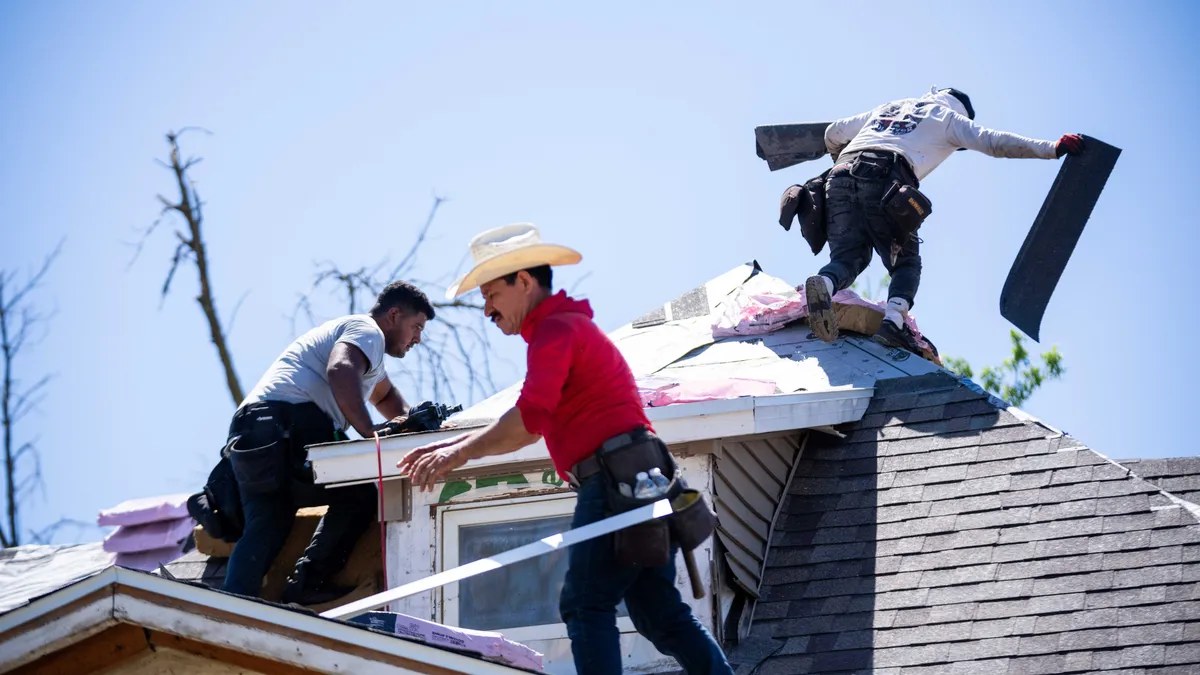
- Iowa Insurance Commissioner Doug Ommen issued cease-and-desist orders against four roofers who allegedly acted as unlicensed public adjusters.
- Customers can hire public adjusters to negotiate insurance claims with carriers, but some in the industry say contractors are illegally negotiating with insurers on clients' behalf.
- Does that hurt consumers? Not everyone agrees
Darren Reeves felt uncomfortable when he received a request for service this spring.
According to an Iowa Insurance Division order, a man approached Reeves in Greenfield on May 24, three days after an EF-4 tornado leveled much of the small town. The man, who identified himself as “Jeremy,” said the storm damaged his sister's home. Reeves, owner of Reeves Roofing, gave the man a business card.
He said the man called him 14 times over the next week, but Reeves was busy repairing other buildings. On May 29, Reeves agreed to meet him on the southwest corner of town. He found the man he knew as Jeremy in front of a two-story, brown house.
Jeremy explained that someone had assessed the home and determined that the storm did not damage the asphalt roof. Jeremy wanted a second opinion. After his inspection, Reeves agreed with the original assessment.
But after the man left, Reeves began to feel uneasy. He said the man had asked a lot of odd, specific questions about how Reeves would handle insurance claims.
In a town of 2,000, gathering intel does not take long. Reeves asked around and learned who owned the home he had just inspected. He knew the owner. He had worked on another one of her houses. He said he called the owner's son-in-law, who didn’t know who the man was or why he would ask for an inspection.
That evening, Reeves texted his friend, Willie Tipling, an Adair County sheriff’s deputy and member of the Greenfield Volunteer Fire Department. He shared a picture of the man, which Reeves captured from the roof.
“I think he was trying to scam (the homeowner),” Reeves wrote.
“I’ll pass this along to the fraud guys,” Tipling responded.
Tipling told the Des Moines Register he reported Reeves’ concerns to Greenfield police, alerting them of a potential scammer.
But three weeks later, Reeves learned that he himself was the supposed scammer— at least, according to state insurance regulators.
In a June 21 news release, the Iowa Insurance Division announced that Commissioner Doug Ommen had issued cease-and-desist orders against four roofing companies, including Reeves' business. The orders accuse the companies of illegally acting as unlicensed public adjusters, the representatives that customers hire to negotiate claims with insurance companies after storms.
Customers assign rights to public adjusters, who charge fees to the customers and receive direct payment from the insurance companies. Unscrupulous contractors have acted as customers' adjusters, taking payments and leaving jobs unfinished. Insurance officials say the problem is particularly pronounced among out-of-state contractors who descend into communities after natural disasters.
As a result, the state does not allow people to act as contractors and public adjusters on the same projects. The state also requires public adjusters to take classes and receive licenses, in an effort to make sure those companies understand Iowa's laws and regulations.
More: MidAmerican has removed tornado-collapsed turbines, but repair, replacement work ongoing
According to the order against Reeves Roofing, Jeremy was an undercover Iowa Insurance Fraud Bureau investigator. The investigator asked Reeves whether a customer would need to submit a claim to an insurance company and whether Reeves could deal with the carrier himself.
“I will handle everything,” Reeves said, according to the order.
The order also cites reviews on Google, Facebook and Reeves’ website that praise him for working with insurance companies on customers' claims. The order states that Reeves indicated to the investigator that he had been an adjuster despite lacking a license, an allegation Reeves denies.
The case underscores insurance regulators’ efforts to crack down on what they believe to be a scourge of fraud, increasing insurance companies' costs at a time when claims have increased.
But roofers and their representatives say the division has pushed too hard this summer, punishing contractors for small mistakes. They say the state’s enforcement of a vague law hurts customers when insurance companies pay smaller claims than they should.
Roofer says investigator 'was clearly trying to set me up'
In an interview with the Des Moines Register, Reeves said the investigator “baited” him with his questions about how he would help on an insurance claim.
“He was trying to get me to fight the claim, argue the claim, do something,” Reeves said. “He was clearly trying to set me up.”
He added: "I never said I was an adjuster. I've never told anybody that."
More: Was the Greenfield tornado the strongest tornado ever? What mobile wind speed data shows.
He said he was tired when he met the investigator, having worked long hours in the eight days after the tornado hit Greenfield. He said he had been repairing buildings for free in town.
Greenfield Mayor Jimmie Schultz, Tiger Drive-In restaurant owner David Huff and Tipling, Reeves' friend, confirmed to the Register that he repaired roofs on a city building, the fire department and multiple businesses and homes for free after the storm.
Adair County Sheriff Jeff Vandewater said Reeves patched one of his department’s buildings without charge, too. He said the insurance division's order against Reeves surprised him.
"He would have been one of the handful of people that I wouldn’t be worried about," Vandewater said.
Reeves accused the Insurance Division of intimidating roofers with its investigation. Often, he said, contractors argue with insurance companies over estimates after storms. He said some companies decline to pay for necessary expenses, like telehandlers, a forklift that contractors use to place shingles and other material on top of roofs.
Reeves said he lost business in Greenfield after news of the investigation broke in late June.
More: Greenfield residents find corn growing near sidewalks, other unusual places after tornado
“They’re abusing that, the cease-and-desist order,” Reeves said. “They’re using it to put it on the radio, to pressure roofing companies into not working with insurance companies.”
Adding to the intrigue: The home where the investigators conducted their sting belongs to Jacque Eblen, a customer service representative for the Adair County Mutual Insurance Association. Reeves said he has gotten into arguments with the county mutual over the company’s "low ball" estimates.
“They’re always off on everything,” he said.
Eblen declined to comment about why the insurance division used her home for a sting. Her boss, mutual President-Treasurer Marcia Kralik, did not respond to a call or email.
Iowa Insurance Division spokesperson Chance McElhaney declined a request for an interview and did not answer questions about the investigation. He also declined to provide recordings of conversations between the undercover employee and Reeves that could clarify discrepancies about what the roofer allegedly promised.
"Prior to filing any administrative enforcement action each investigation is reviewed to ensure that any allegations are supported by the evidence," McElhaney said.
Insurance Division: 'Attempts to prey on residents impacted by the storms will not be tolerated'
The Insurance Division’s crackdown on roofers comes as property insurers struggle in Iowa, which has experienced an increase in windstorms since 2020. Companies have exited the Iowa market, while others have hiked premiums, sometimes more than 100%.
Insurers also have decreased the amount they will pay for roof damage, the Register has previously reported. The slimmed-down coverage leaves some Iowans paying five-figure bills out of their own pockets.
The recent cease-and-desist orders are part of a wider enforcement effort against residential contractors who insurance insiders believe are acting illegally. In addition to Greenfield, McElhaney said the Insurance Division dispatched employees to Cambridge, Minden and White Oak after tornadoes hit those towns this spring.
He said "contact was made" with 73 contractors to educate them on the laws and prevent fraud. He said the Insurance Division wants to protect Iowa homeowners, contractors, adjusters and insurers who obey the laws.
He said eight contractors received cease-and-desist orders or were the subject of criminal referrals from the Insurance Division this year, up from a total of four cases in the prior three years.
The Insurance Division has also issued 44 warning letters this year, up from a total of 13 the prior three years.
“Post-disaster attempts to prey on residents impacted by the storms will not be tolerated and will be investigated thoroughly by the Iowa Insurance Division,” division Deputy Commissioner Jared Kirby wrote in a June 18 letter addressed to "the Iowa Insurance Industry."
Kay Godfredsen, a private attorney and former Iowa Insurance Division first deputy commissioner, who oversaw the regulator's fraud bureau, said the state may argue that contractors interpreting policies for customers warrants an Unlicensed Practice of Public Adjusting Charge.
The same could happen to contractors who explain how to file insurance claims or negotiate with an insurance company about "certain aspects of the loss."
Godfredsen recommends that contractors understand the details of Iowa's laws and regulations about public adjusting. She also recommends that they ask attorneys to review their websites to make sure the companies don't make any statements that indicate they will act as adjusters.
"I empathize that these lines can be blurry and that the customer is oftentimes in a state of confusion (especially after these recent traumatic storms)," she said in an email.
More: From abortion to sidewalk repair, Iowa Supreme Court looks at past cases with new eyes
Caedan Tinklenberg, president of the Iowa Association of Public Insurance Adjusters, said the state’s crackdown harms customers. He said local contractors sometimes know Iowa laws better than out-of-state insurance representatives.
For example, he said, state law requires insurance companies to replace damaged housing material with supplies that look uniform across the exterior of a home. If a hailstorm damages old siding that is no longer available, Tinklenberg said, the insurer has to replace all of the home's siding that is visible with a new material.
He said contractors often have to inform insurance representatives about the requirement.
“It evens the playing field between the insurance company and the policyholder,” Tinklenberg said. “Without the contractor there, these insurance companies would regularly and routinely get away with denying claims.”
Customers can hire licensed public adjusters to make similar arguments, but most homeowners can't afford them. Tinklenberg said the state passed public adjusting laws to protect consumers, something he doesn’t think the recent investigations accomplished.
According to a warning letter viewed by the Register, the department told a contracting firm it was out of line with the law because it “states, offers, presents or advertises that your company will become involved with the consumer’s insurance company negotiating for or effecting the consumer’s insurance claim.”
The letter does not point to any specific advertisements or public statements from the company. It also does not cite any of the company's specific actions.
More: Greenfield welcomes thousands in donations as RAGBRAI riders witness EF4 tornado damage
The letter lists statements that contractors legally can’t make, including “we are insurance claim experts” and “we advocate for homeowners.”
“This letter is a warning that further instances of misconduct will result in administrative violation(s) and a referral to law enforcement officials for consideration of criminal prosecution,” wrote David Sullivan, assistant bureau chief for the division’s market regulation bureau.
Tinklenberg said he met with Kirby Aug. 7 after receiving complaints from roofers.
“He (hadn't) been talking to me or other public adjusters," Tinklenberg said. “And to my knowledge, he hasn’t been talking to contractors. The only information he’s getting about these claims and how they’re handled is from the insurance companies.”
Roofers say they are innocent, are not acting as public adjusters
Other roofing companies have pushed back against the cease-and-desist orders.
In his filing against Illinois-based American Dream Home Improvement, which operates in Iowa as AmeriPro Roofing, Ommen, the insurance commissioner, wrote that the company’s website advertised public adjusting services. The site tells customers to contact AmeriPro before filing insurance claims and offers to “help you fill out the forms accurately.”
“We can deal with the insurer for you and make sure you get all the necessary work paid for in full before the job,” the site said, according to the order.
In a July 18 petition to vacate the order, AmeriPro’s lawyers wrote that the company does not advertise public adjusting work. They said the company offers to help customers with their claims but does not meet with insurance company representatives without the customer. The lawyers said a section of the company website states, “We do not offer or contract public adjusting services.”
The Insurance Division’s order adds that an AmeriPro sales representative pitched the company’s services to the owners of storm-wrecked homes, even though the company does not have a solicitor’s license from the city of Greenfield.
Schultz, the city’s mayor, said Greenfield requires the licenses to protect residents from “rip-off artists.”
In another order, against Des Moines-based Recon Roofing & Construction, Ommen wrote that the company has operated with a form contract that states that employees will provide adjusting services. The company’s website, meanwhile, states that Recon employed an insurance adjuster on staff, which was not true.
In a response, a lawyer for Recon denied that the company has ever acted as a public adjuster. Daniel Shipton, Recon’s general manager, told the Register that the company has removed references to adjusting services from its website, updated its contracts and re-trained staff to ensure they don’t violate state law.
He called the errors “honest mistakes.” He said an out-of-state company built Recon’s website and may not have known about Iowa’s public adjusting laws. He conceded that Recon was responsible for the site.
“We have not been sitting on our heels at all,” Shipton said.
Next steps in these cases
The companies that resisted the regulators’ cease-and-desist orders will go before Ommen for public hearings this fall.
The commissioner are scheduled to hear Recon’s case Sept. 23 and 24 and Reeves’ case Nov. 1. AmeriPro signed a consent order with the Insurance Division on Sept. 5, the regulator announced in a news release. AmeriPro agreed to change its contracts, website and advertisements. The company's employees will also no longer offer to help customers negotiate insurance claims.
A fourth company, Marshalltown-based Exterior + Home Remodeling, did not request a hearing by a 30-day deadline, McElhaney said in an email. That cease-and-desist order went into effect.
A guide for customers
A public adjuster is a licensed company or person that customers hire to negotiate claims with insurance companies. Public adjusters must have posted bonds. They can charge customers up to 10% of their insurance claims. A storm that causes $100,000 in damage could result in $10,000 for the public adjuster.
"Unlicensed public adjusting can be rife with fraud, taking advantage of property owners, exaggerating damage estimates or charging excessive feeds," an Iowa Insurance Division representative wrote in a "Scam Alert" warning about the practice.
The state maintains an searchable, online database of all licensed public adjusters at data.iowa.gov/Regulation/Public-Adjusters-Licensed-in-Iowa/rw5w-dmcr/about_data.
According to the Insurance Division, customers should know what kind of work contractors can and can't do. Contractors can:
- Recruit customers if the employee has a solicitor's license.
- Give opinions about whether a storm damaged a building.
- Estimate repair costs.
- Tell customers what work the company must do to repair buildings.
- Observe an insurance company's inspection.
- Answer insurance companies' questions about estimates.
- Prepare insurance claims.
- Negotiate insurance claims.
- Review insurance policies or advice customers about their policies.
- Advertise public adjusting services, including referring to employees as "claims specialists" or similar terms.
- Partner with licensed public adjusters.
How to complain about insurance companies, contractors
If contractors break the public adjusting laws, the Insurance Division asks customers to email investigators at [email protected].
Customers can also complain about insurance companies on the Insurance Division's website.
Tyler Jett is an investigative reporter for the Des Moines Register. Reach him at [email protected], 515-284-8215, or on X at @LetsJett. He also accepts encrypted messages at [email protected].