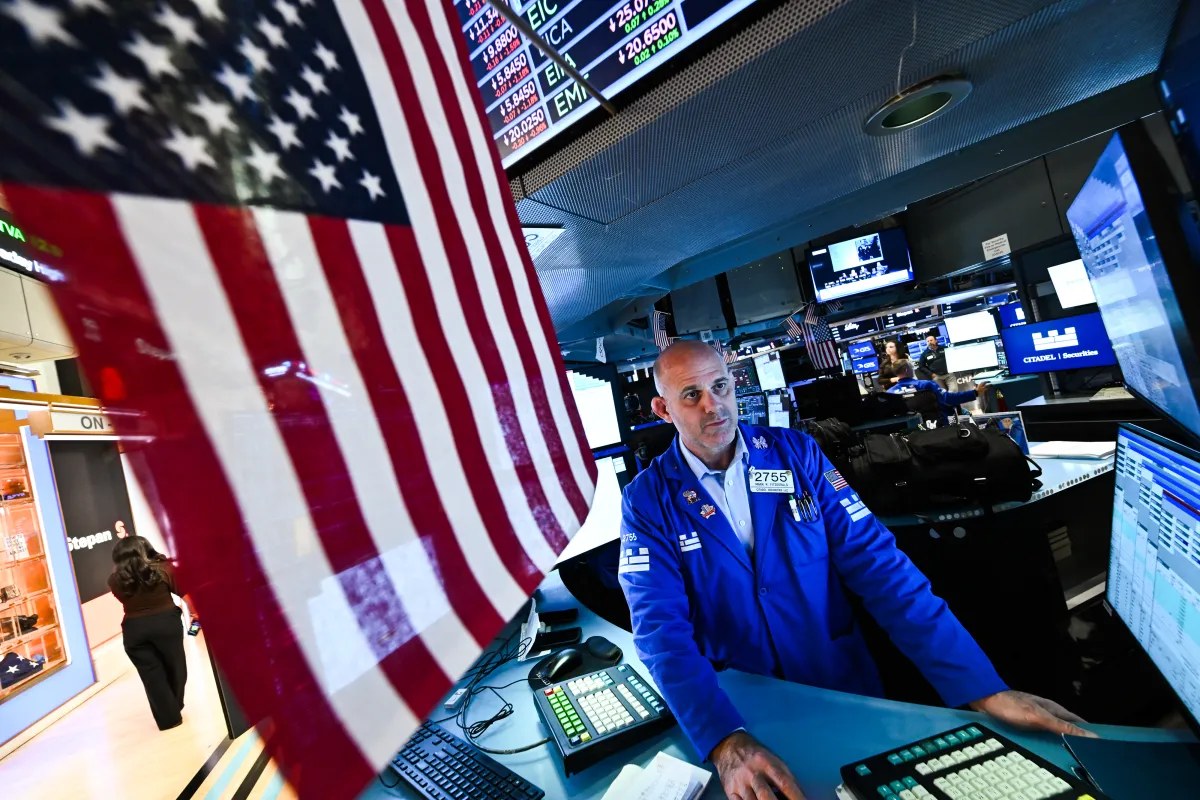
The Dow Jones Industrial Average plunged more than 1,100 points Thursday, dropping below the now-infamous 50,000-point milestone Pam Bondi highlighted during her contentious congressional testimony on sex offender Jeffrey Epstein.
The decline marked the index's first close below that threshold since June, bringing renewed attention to a figure that became a political talking point earlier this year.
Bondi, who was then attorney general, invoked the index's performance while facing questions from lawmakers about the Justice Department's handling of the Epstein investigation.
Read More on News
“The Dow is over 50,000 ... I don't know why you're laughing. You're a great stock trader, as I hear, Raskin,” Bondi said, addressing Representative Jamie Raskin. At the time, Bondi was pointing to the index's record-breaking performance as evidence of the Trump administration's economic achievements.
The blue-chip index lost 1,101.11 points, or 2.19 percent, to close at 49,097.06 on Thursday. The S&P 500 shed 2.02 percent to finish at 7,175.83, while the tech-heavy Nasdaq composite dropped 2.25 percent to close at 23,879.20.
Thursday's sell-off came amid growing concerns about the artificial intelligence industry, regulatory oversight and the prospect of more aggressive Federal Reserve interest rate increases.
Investors were closely watching Nvidia (NVDA), whose shares reversed early gains Thursday, sliding 3.3 percent to $145.98 despite the company's stronger-than-expected quarterly results earlier this week. The decline brought the stock back to levels last seen in late 2024.
Why Pam Bondi's 50,000 Dow Remark Became a Political Talking Point
The 50,000 milestone has an unusual connection to one of the most contentious congressional hearings of 2026.
On February 11, Bondi appeared before the House Judiciary Committee as lawmakers questioned her about the Justice Department's handling of documents connected to Epstein, the disgraced financier.
During the hearing, lawmakers pressed the attorney general about the release of Epstein-related records, the treatment of victims and whether the department was pursuing additional investigations. Bondi responded by defending the administration's handling of the documents and criticizing Democrats for focusing on Epstein.
“The S&P at almost 7,000, and the Nasdaq smashing records. Americans' 401(k)s and retirement savings are booming. That's what we should be talking about," Bondi said, arguing that Americans' 401(k) accounts and retirement savings were benefiting from the strong stock market.
Her comments drew laughter from the committee, with lawmakers questioning the relevance of stock market performance to the subject of the hearing.
Bondi nevertheless doubled down, celebrating the Dow's achievement and crediting President Donald Trump with reaching the milestone much earlier than critics had expected.
The exchange became one of the most memorable moments of the hearing, linking the Dow's performance to a broader political debate about the administration's economic record.
The 50,000 figure was never an official economic threshold. Rather, it became a symbolic benchmark after Bondi used it to defend the Trump administration during questioning about Epstein, the sex offender.
Newsweek has reached out to Bondi for comment.
Nvidia's Earnings Fail to Deliver a Lasting Rally
Nvidia reported stronger-than-expected third-quarter results, initially giving investors reason for optimism. The upbeat report, however, failed to sustain momentum, with shares reversing course Thursday.
The company reported adjusted earnings of $2.68 per share on revenue of $115.84 billion for the quarter ending October 25.
Wall Street analysts had expected adjusted earnings of $2.48 per share on revenue of approximately $109 billion. Revenue increased 103 percent year over year, reinforcing the company's position at the center of the global artificial intelligence infrastructure boom.
“Our momentum is real,” Nvidia’s interim CEO, Colette Kress, told investors and financial analysts of the results. “Our demand is accelerating. Our supply is growing. Our customers and our partners are with us. And employees are committed. We’ve got this.”
Investors were also considering a reported Securities and Exchange Commission investigation into whether Nvidia's disclosures may have misled investors, according to The Wall Street Journal.
The reported inquiry adds another source of uncertainty for the chipmaker, which has also faced questions surrounding its leadership following reports involving former CEO Jensen Huang.
Nvidia's board has said it is not considering bringing Huang back.
The combination of leadership uncertainty, regulatory scrutiny and concerns about the sustainability of AI spending has weighed on investor sentiment.
When Did the Dow Last Fall Below 50,000?
The Dow Jones Industrial Average first closed above 50,000 on February 6, 2026, finishing the session at 50,115.67.
The achievement came after a volatile period for Wall Street, with investors increasingly concerned about artificial intelligence valuations, technology spending and the broader economic outlook.
However, market data shows the index subsequently slipped below the milestone, closing at 49,451.98 on February 12 and 49,662.66 on February 18.
It later recovered and climbed higher. By June, it had moved back above 50,000, and Thursday's close marked its first finish below the threshold since.
The difference is that the Dow's February breakthrough was accompanied by a strong rally, while Thursday's decline came amid renewed uncertainty surrounding technology stocks, inflation and interest rates.
Peter Schiff, chief economist and global strategist at Europac.com, said there’s a “good chance” the stock market is about to lose all of its gains since Trump took office.
“Of course, Trump will blame the entire decline on the Democrats winning the midterms,” Schiff wrote on X Thursday. “He will also be able to blame the Democrats for the recession that follows. How convenient.”
Could Anthropic's IPO Lift the Stock Market Again?
Anthropic's highly anticipated IPO offered another test of investor appetite for artificial intelligence companies.
The company behind Claude made its stock market debut Thursday, with shares surging and briefly pushing its valuation above $2 trillion. The offering raised a record $81.3 billion, making it the largest IPO in history, despite growing concerns about a potential AI bubble and the technology's impact on jobs and livelihoods.
Anthropic's listing could have a more direct influence on technology-focused investments because its shares are now listed on the Nasdaq. Strong demand could encourage renewed buying in AI-related stocks, although the impact may be more pronounced in technology stocks than across the broader market.
Federal Reserve Rate Concerns Return
Interest rate uncertainty is another factor affecting Wall Street.
Federal Reserve Governor Christopher Waller told CNBC Wednesday that the central bank might need to deliver a half-percentage-point rate increase to bring persistent inflation under control.
Such an increase would be larger than the quarter-point moves typically associated with the Fed's recent policy adjustments. The comments raised concerns about the possibility that borrowing costs could remain elevated or increase further.
Higher interest rates can weigh on stock valuations by making bonds and other fixed-income investments more attractive relative to equities. They can also increase financing costs for businesses and households.
Technology companies with valuations based heavily on expectations of future growth can be particularly sensitive to changes in interest rate expectations.
The Federal Open Market Committee is scheduled to meet December 8-9. Investors were also awaiting the release of minutes from the Fed's October meeting for additional clues about policymakers' thinking.
Healthcare Stocks Add Pressure to the Dow
The weakness was not limited to technology companies.
Healthcare stocks also weighed heavily on the Dow after the Centers for Medicare & Medicaid Services proposed a new anti-fraud rule affecting insurance providers.
The proposed Comprehensive Regulations to Uncover Suspicious Healthcare, known as the CRUSH rule, would increase audits of insurance companies and could require providers to return certain overpayments.
UnitedHealth Group and Humana's shares both fell around 6 percent.
Because the Dow is a price-weighted index containing 30 major companies, substantial declines in some of its largest components can have an outsized effect on its performance.
The healthcare sell-off added to the pressure on the index alongside concerns about technology stocks.
What Happens Next for Wall Street?
The next several trading sessions could prove important for investors attempting to determine whether the recent weakness represents a temporary correction or the beginning of a more prolonged downturn.
Nvidia's earnings have provided evidence that demand for AI infrastructure remains strong, but the market's reaction suggests investors are increasingly concerned about valuations, corporate leadership and the financial sustainability of the AI boom.
Meanwhile, Waller's comments have introduced another source of uncertainty as traders consider the possibility of additional monetary tightening.
Anthropic's successful debut demonstrated that investor demand for AI companies remains substantial, but it did little to prevent Thursday's broader market sell-off.
With the Dow now below 50,000, the more important question for investors is whether the forces weighing on Wall Street begin to ease before the end of the year. The broader market will need reassurance that inflation is moderating, corporate earnings remain resilient and the Federal Reserve is not preparing to raise borrowing costs aggressively.
Newsweek’s reporters and editors used Martyn, our AI assistant, to produce this story. Learn more about Martyn here. Contact Newsweek editors on this story: Steven Frank and Edward T. Cummins