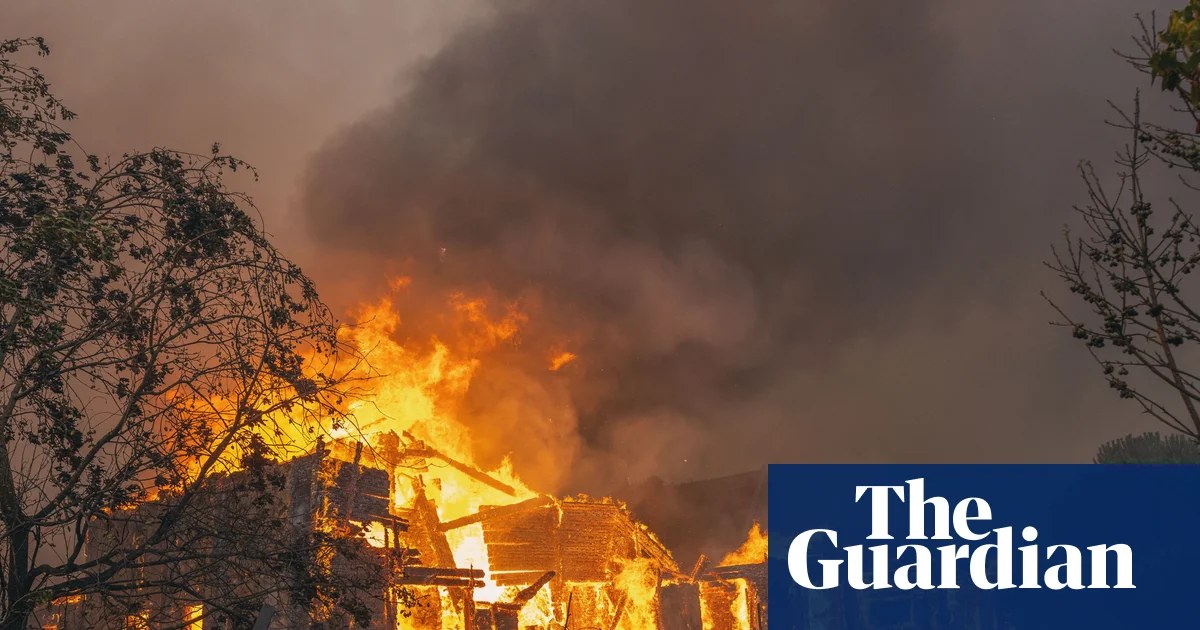
Authorities in France are battling to contain a huge wildfire near Bordeaux in the south-west as Spain’s prime minister, Pedro Sánchez, warned Spain and the Iberian peninsula were suffering the effects of the climate emergency.
Efforts to extinguish the blaze in the Gironde region of France – which has consumed an area four times the size of Paris and caused nearly 220,000 people to be evacuated – were hampered by windy conditions on Saturday night.
In Spain, fires west of Madrid were being brought under control, but Sánchez spoke of “difficult hours”.
Wildfires have forced approximately 375,000 people to flee their homes in France and Spain. In France nearly 260,000 have been forced to flee, while in neighbouring Spain 116,000 have been evacuated this week.
Bordeaux’s mayor, Thomas Cazenave, described the Gironde blaze as being “at the gates of the metropolitan area”, between 15 and 20 miles (25-30km) from the city itself, which has a population of 268,000. An evacuation of the city was not on the cards, he said.
Nearly 260,000 people have been evacuated across France as a whole, including 36,000 ordered to leave another wildfire zone in the Landes region farther south earlier this week.
Sophie Brocas, the prefect of the Nouvelle-Aquitaine region, which includes the Gironde, said that the highly unpredictable nature of this wildfire was a phenomenon never seen before in France. “I urge tourists not to come to Gironde as long as the fire has not been contained,” she said. “I invite tourists who are already here to think about going to another destination. We don’t know where the fire is going to go.”
France’s interior minister, Laurent Nuñez, said on Sunday the previous night had been difficult and “the situation remains very unfavourable”. He said the Gironde fire had become “extremely virulent and unpredictable again” on Saturday night, generating its own wind and spreading erratically towards the Bordeaux metropolitan area. It had become calmer by the end of the night, he said.
About 2,500 firefighters (including a Swiss team), 1,500 military personnel and about 1,200 police had been deployed to Gironde, Nuñez said, as he praised the contribution of 450 volunteers from civil security organisations.
He said another five Gironde municipalities had been evacuated overnight.
One firefighter told Agence France-Presse that the fire had formed a pyrocumulonimbus, a fire-generated thunderstorm that “creates its own wind, with whirlwinds, becoming erratic and uncontrollable”.
A spokesperson for the National Firefighters Federation of France said that while known in wildfire-prone Australia and Canada, one had never been seen before in France. The federation’s Lt Col Éric Brocardi told AFP there was a need to understand a “natural force beyond our control”. He said: “It’s a David v Goliath scenario: the idea is that, at some point, we’ll find a weak spot and strike there.”
Police in Gironde made three arrests over the weekend, including one man smoking in the forest and two having barbecues in a forest area.
Authorities in Spain said major areas of fire near Madrid had been contained and cooled down, according to a senior officer with Spain’s military emergencies unit.
“We’re facing some difficult hours, although it’s true that the latest update has shown that last night was very positive in terms of the fire’s evolution and efforts to control it,” Sánchez said.
Speaking at an advance firefighters’ command post west of Madrid, the prime minister warned that Spain and Portugal were experiencing the varied consequences of the climate emergency, from fires and storms to heavy snowfalls. “The entire Iberian peninsula is suffering the effects of the climate emergency in a very specific way,” he said.
While the fire near Madrid was being brought under control, emergency workers battled to extinguish a new fire near the Mediterranean port city of València, where at least 15,000 people were evacuated. “The fire is beyond our capacity to extinguish, it has a perimeter of about 21km,” the València region’s president, Juanfran Pérez Llorca, said late on Saturday.
Spain’s interior ministry said on Saturday evening that a man had died in a fire in the Valèncian town of Manises. He had been found in a car in a ravine, officials said.
Authorities also ordered the evacuation of eight more municipalities near Toledo, south of Madrid, on Saturday, bringing the number of people forced to flee their homes by wildfires in Spain in recent days to 116,000, the Associated Press reported.
Spain’s environment minister, Sara Aagesen, said the wildfire that has burned through 50,000 hectares of land in the central province of Ávila was “the largest forest fire in our country’s recent history”.
The blazes are the latest episode in a summer of wildfires that threaten to burn an unprecedented expanse of land. Europe has endured a series of heatwaves since the spring, fuelled by the climate crisis, including the hottest-ever June, leaving vegetation tinder dry.
The EU commissioner for crisis management, Hadja Lahbib, told the BBC it was likely that damage from wildfires would exceed previous records. “Last year, one million hectares burned during the summer and so we are expecting to face another historic, sad record because the season has started earlier in the year,” she said.
Spain’s environment ministry said 32 major fires affecting 152,678 hectares (377,276 acres) had been recorded so far in 2026, compared with seven affecting 24,133 hectares in the same period in 2025.
The Gironde fire in France has so far burned 42,000 hectares, an area four times the size of Paris and one of the biggest devastations of land since the second world war.
At least 240 homes had been destroyed and many more damaged, a gendarme told BFMTV.
Firefighters are battling to slow the fire’s progression toward Bordeaux from the ground and air, with planes dropping water and retardants. Jérôme Steffe, the mayor of Cestas commune, 10 miles from Bordeaux city centre, told French media: “We are working together to put in place a firewall to block the advance of the flames.”
An exhibition centre in Bordeaux has been turned into an emergency shelter, providing camp beds and food for thousands of people, including hundreds of older people evacuated from care homes.
Cazenave said he had asked the central government for an economic crisis plan for the area because many businesses and workers had been evacuated from areas west of Bordeaux and the tourism industry had been heavily affected. He said it was impossible to say when people evacuated as a precaution could return to their homes.
“We don’t know how long this crisis will last, whether several days or several weeks,” he said.
The Landes fire has consumed 3,600 hectares and a rekindling of flames on Saturday had to be tackled from the air, Nuñez said. French authorities are also dealing with wildfires in the south-eastern Var region, where 3,000 people have been evacuated, as well as the Hautes-Alpes and Corsica.