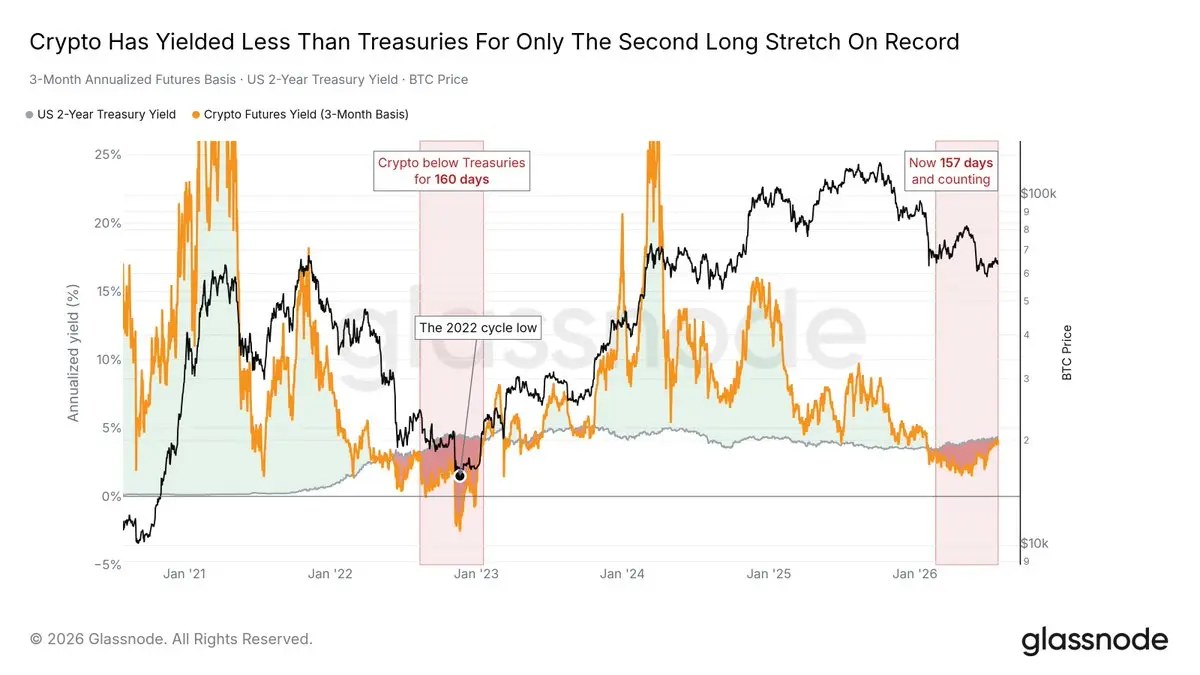
Bitcoin futures’ once-rich carry has evaporated, with quarterly basis yields trailing two‑year U.S. Treasuries since February, a sign of shrinking arbitrage and a maturing market.
- Once yielding more than 20% during the 2021 bull market, the bitcoin futures carry trade has paid less than short-term U.S. Treasuries since February.
- Slumping carry returns and a broader crypto bear market have driven bitcoin futures volumes sharply lower.
Once a goldmine for carry traders, bitcoin futures have flipped, consistently underperforming plain‑vanilla U.S. Treasuries every month since February.
Carry trades consistently yielded 20% or more across regulated and unregulated crypto exchanges during the 2021 bull market. The strategy involved shorting bitcoin
Traders have long used futures, agreements to buy or sell an asset at a set price on a specific date, to set up trades that profited from the gap between futures and spot prices, known as basis. That basis, in annualized terms, has been lower than the two‑year Treasury note continuously for more than five months, according to data source Glassnode.
"Three-month futures basis has paid less than a two-year Treasury since February. Only one other stretch on record has run this long: August 2022 into January 2023. It ended at the cycle low," Glassnode said in a post on Telegram.
The three-month basis has been yielding less than the two-year Treasury note for 157 days, according to Glassnode's Sunday chart.
If carry pays less than short-term Treasuries, allocators and traders lose an incentive to deploy capital into futures. A dollar in the carry trade now earns less than it would sitting in government paper.
This partly helps explain the slowdown in bitcoin‑futures activity. July volume was just over $880 million, extending the decline from February’s $1.47 trillion peak, according to Coinglass. The drop also reflects the broader crypto bear market.
That decline in the basis actually signals greater liquidity and market maturation. The basis trade profits from price discrepancies between linked markets. Hence, a collapsing yield means those inefficiencies are shrinking, paving the way for tighter bid-ask spreads, easier hedging, and fewer outsized arbitrage opportunities.
Binance remains crypto’s leading exchange, expanding from spot and derivatives into RWAs, payments, savings, yield, and broader financial services.