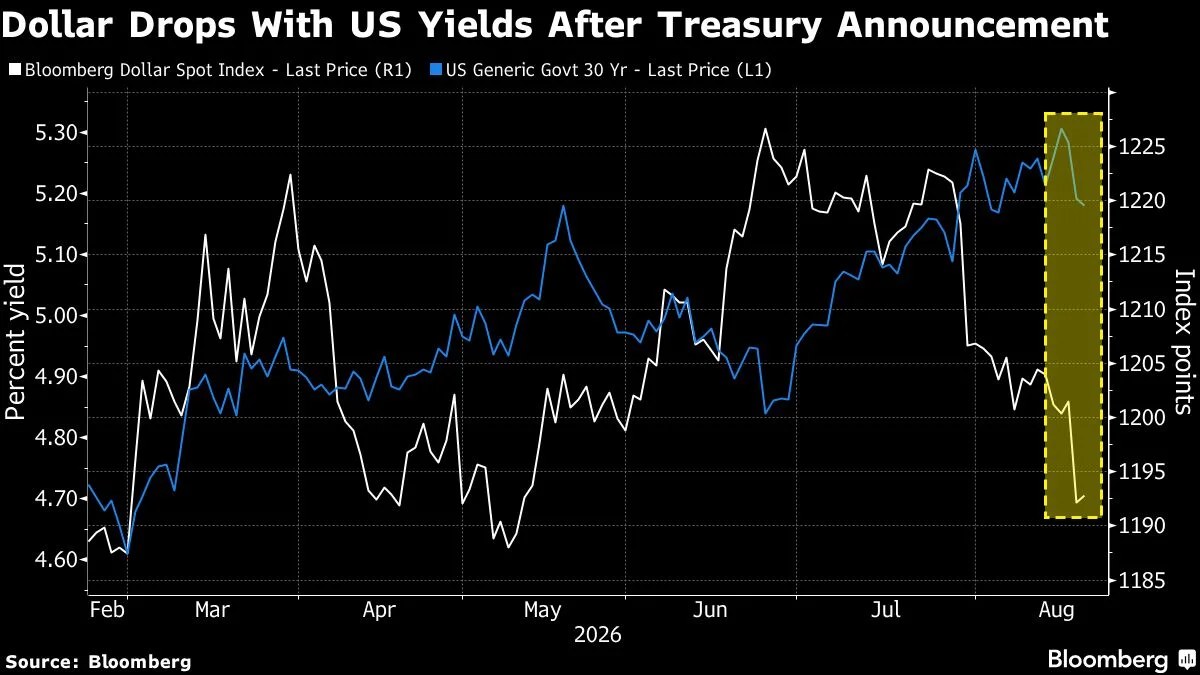
(Bloomberg) -- Treasury Secretary Scott Bessent's bold intervention to stem a potentially damaging rise in US borrowing costs has some investors saying the dollar will ultimately pay the price.
Some market participants see the move as a turning point, with Washington taking a more active role in keeping its borrowing costs down. Coming after other recent efforts to rein in long-term yields, it's reviving a concern that US policy could weaken faith in the dollar and push investors toward alternatives.
"The dollar certainly is the biggest casualty," said Gerald Gan, chief investment officer at multi-family office firm Reed Capital in Singapore. He sees Bessent as deliberately pushing down long-term real rates and signaling a tolerance for a weaker dollar to keep the economy afloat.
"I would further diversify away from the dollar," he added.
The Treasury said Wednesday it would "at least double" planned purchases of outstanding 10- to 30-year bonds after borrowing costs surged to multi-year highs, making Bessent the most interventionist Treasury chief in decades. The move marked a departure from the department's longstanding "regular and predictable" approach to debt management — something Bessent himself endorsed in a speech in November.
Any attempt to engineer US yields lower can reduce the attractiveness of dollar-denominated debt relative to assets elsewhere. And if investors see the goal as easing the path for additional American borrowing, that can also have the impact of devaluing the US currency.
A Bloomberg gauge of the greenback fell to a three-month low after the announcement before edging up 0.1% on Thursday. The yen, Swiss franc and New Zealand dollar were among the biggest gainers against the US currency.
The buyback plan comes just weeks after the US joined Japan in intervening to support the yen, adding to the sense that policymakers are panicking, said Amir Anvarzadeh, strategist at Asymmetric Advisors in Singapore.
"I don't think they are trying to weaken the dollar so much but to try to stabilize the yields — but the sacrificial lamb is the dollar," he said.
Audrey Childe-Freeman, chief FX strategist at Bloomberg Intelligence, also sees the move as potentially bearish for the dollar. "Traders are likely to view this as an attempt to suppress market pricing around US fiscal sustainability and the Fed's inflation-fighting credibility," she wrote in a note.
Long-term Treasury yields surged this week as investors demand more compensation to lend to a government with a growing debt burden. Inflation worries and competition from a wave of corporate borrowing added to the pressure, pushing the 30-year yield to levels last seen in 2007, even as expectations for an imminent Federal Reserve rate hike have faded.
Washington was already showing signs of concern before Wednesday's buyback announcement. After the US joined Japan in supporting the yen late last month, Bessent floated using a Fed facility to finance further intervention if needed. The moves were seen as reducing the risk that Japan would have to sell Treasuries to raise dollars to defend its currency.
Together with President Donald Trump's occasional embrace of a weaker dollar, the actions have reinforced a sense among some investors that Washington is increasingly willing to intervene in markets to keep borrowing costs in check.
"Bessent would welcome these FX movements, as the Trump administration has been praising the benefits of a weaker dollar as a way to increase US competitiveness and reduce trade imbalances," Evercore ISI strategists including Marco Casiraghi wrote in a note.
Andrew Canobi, a director of fixed income at Franklin Templeton in Melbourne, sees the bigger story playing out in currencies. Bessent is "effectively saying we're prepared to sacrifice a bit of dollar strength in order to keep term yields somewhat in check," he said. "Something has to be the relief valve."
The alternative would be to tackle the country's structural problems, he said — a much harder path — leaving policymakers to either manage yields or allow the dollar to weaken.
The dollar has weathered similar hand-wringing before. The Fed's massive bond-buying programs in the past stoked concerns that attempting to suppress yields and expanding its balance sheet could debase the currency. More recently, investors cut exposure amid Trump's tariff threats and pressure on the Fed. None has dislodged the dollar from its dominant role in global markets.
Not everyone sees an immediate threat to the dollar. It still has strong near-term support from AI-driven inflows into US equities and higher oil prices, according to Masahiko Loo, senior fixed income strategist at State Street Investment Management.
But Loo said the latest measures reinforce a longer-run case for de-dollarization and currency debasement. As sovereign AI initiatives and data-center buildouts broaden beyond the US, the exceptional capital-flow advantage enjoyed by the US today could gradually erode, he added.
"The dollar is shaping up as the weak link for investors weighing Treasury buybacks against the US's widening fiscal deficit. That gives Asian currencies room to run."
— Mark Cranfield, Markets Live strategist.
Shoki Omori, Deutsche Bank AG's chief fixed income strategist for Japan, said greater liquidity support for Treasuries comes almost by construction at the dollar's expense.
The price action was telling. Short-term bonds got sold off and Fed hike expectations held firm, yet the dollar fell broadly — a sign that investors are looking beyond interest-rate differentials and questioning the broader US policy mix, he said.
He expects the yen to be the biggest beneficiary over the next three to six months, as Washington's recent moves are removing two forces that have kept the currency weak, namely the need for Japan to sell Treasuries to finance intervention and the pressure from rising US long-term yields. He also favors gold, followed by the Swiss franc and euro, as alternatives to the dollar.
"The Treasury can buy back its bonds; it cannot buy back the dollar," he said.
--With assistance from Matthew Burgess and Masaki Kondo.