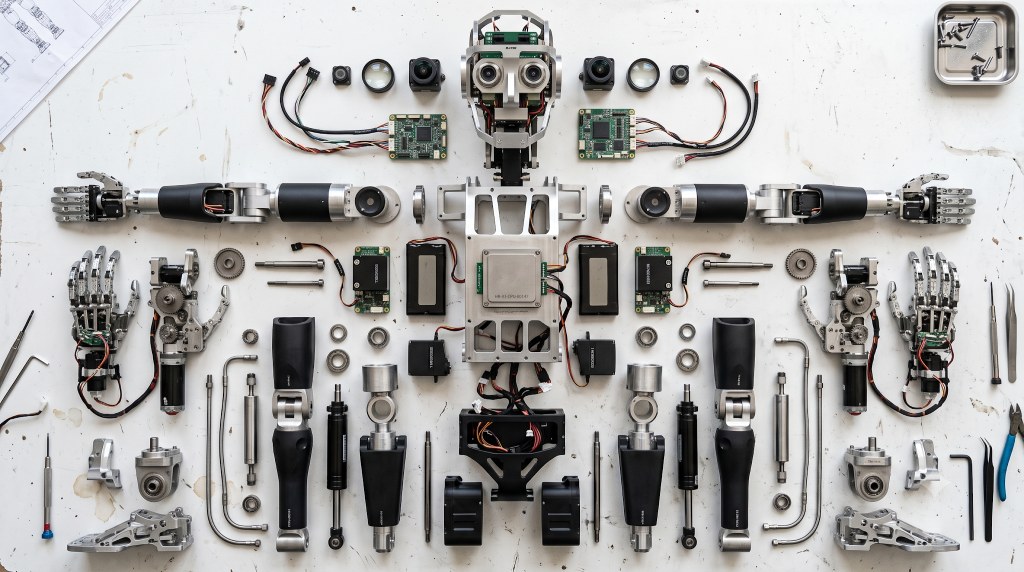
It’s the middle of summer, and what better way to spend some of those extra hours of sunlight than to take on a fulfilling project? The team at the ROBO Global Robotics and Automation Index (ROBO) thought we’d help you get started by putting together a guide to the parts and technology required to build your very own humanoid robot.
Key Takeaways
- Constructing a humanoid robot relies on integrating advanced technology across three main areas: a “brain” (AI chips, cameras, and sensors for spatial awareness), a “body” (rotary and linear actuators for precise, muscle-like movement), and “energy” (next-generation solid-state batteries to balance power requirements with weight and safety).
- The primary appeal of a humanoid robot is its shape. Because it is designed to mimic the human body, it can easily navigate spaces and use tools originally designed for people, making it highly adaptable for practical tasks like household chores or factory work.
- The humanoid market is booming, with dozens of new commercial models launching regularly. Individuals can participate in this growing industry by investing in the companies and suppliers driving the technology, tracked by indexes like the ROBO Global Robotics and Automation Index.
The appeal of having your own humanoid robot is clear. A robot that shares the same shape as you can theoretically move around the same places you already can and do the same things that you already do. That could be tidying up toys in your living room, unloading the dishwasher, or making widgets at the widget factory. This gives this form factor the potential to have a much more direct impact in your day-to-day life than, say, an industrial robot arm.
Building a robot requires a lot of moving parts, literally. And since this is cutting-edge robotics, you’ll often need to combine technology from multiple companies rather than buying everything off the shelf. To get you started on this project, we’ll break down the core components your humanoid will require: a brain (head), a body (shoulders, knees), and energy to power itself (batteries).
Deconstructed: The Core Components of Your Very Own Humanoid Robot
Source: Image generated by Google Gemini
Brain: AI Chips and Spatial Awareness
Given that this humanoid will walk among you and your loved ones, you will want it to be aware of its environment. For this, you need a combination of sensing and computing. After all, the robot should not only be capable of moving its limbs but also understanding where it is and the properties of the things it is interacting with. Think of it this way: If the task is to unload a dishwasher, it must be able to find the kitchen without stepping on Fido, open all kinds of drawers, and understand that it needs different grips to hold pans and champagne flutes.
To handle this, the robot relies on a mix of physical sensors and onboard processors. For sensing, your humanoid will use things like arrays of cameras and LiDAR to map out the room in 3D so it can navigate safely. It will also need tactile sensors in its hands to measure exactly how much pressure to apply to those fragile flutes. All that incoming data is then sent to an onboard computer. These brains are typically powered by specialized AI chips that process the information in real time and dictate the robot’s next move.
Body: Smart Actuators and Robotic Hardware
Anyone whose knees and muscles don’t move quite as fast as they used to will sympathize: A brain is only as good as the hardware it’s moving. Humanoids rely on actuators to move their limbs. You can think of these as smart joints that pack a motor, gears, and driver electronics into a single housing, giving the robot the strength and precision needed for whatever task is at hand.
Most modern humanoids rely on a mix of electric actuators to get the job done. Rotary actuators are used in places like the shoulders and hips to provide a wide, circular range of motion. On the other hand, linear actuators handle the push and pull movements, mimicking how muscles like your biceps or calves operate. Inside these joints, engineers often use specialized gearing, like harmonic drives. These components provide high torque in a compact package and ensure the robot can move smoothly or hold a heavy pan steady without jittering.
Energy: Next-Gen Batteries and Power Management
All of this computing and moving requires significant energy, but powering a humanoid is not just about having a large battery. After all, the bigger the battery, the more power is needed just to walk around.
Because of this weight penalty, humanoids are increasingly able to both charge and change their own batteries, and the industry is starting to look beyond standard lithium-ion to next-generation solid-state batteries. These aim to pack more energy per pound while eliminating flammable liquid electrolytes, keeping your humanoid lighter, safer, and running much longer before it needs a recharge.
Intrigued by Humanoids, But Want to Skip the Heavy Lifting?
If this overview already sounds like too much work for your summer months, do not despair. Many companies are doing the hard work for you. While access will vary by location, your options are still vast. Even in the United States, following the recent FCC ban on Chinese-manufactured humanoids, consumers can still choose from approximately 65 different models. In such a booming market, you will have plenty of options.
For those who would rather own a slice of the humanoid revolution than build one themselves, the ROBO Global Robotics and Automation Index tracks innovators across the entire robotics spectrum, capturing both humanoid manufacturers and the suppliers providing their core components. Guided by a Strategic Advisory Board of world-renowned AI and robotics pioneers (including four PhDs and two Engelberger Award winners), the index strategy is designed to capture true leaders in the field.
To learn more about what goes into humanoids, subscribe to our newsletter. We will be diving deeper into the brains, bodies, and energy systems of humanoids, while highlighting the specific companies bringing these components to life.
ROBO is the underlying index for the ROBO Global Robotics & Automation ETF (ROBO), the L&G ROBO Global Robotics and Automation UCITS ETF (ROBO.LN), and the Global X ROBO Global Robotics & Automation ETF (ROBO.AU).
Related Research
World Cup 2026 Sees Physical AI in Action
Investing in the Exponential Humanoid Wave
2026 Robotics Update: The Physical AI Ecosystem
For more news, information, and analysis, visit our Artificial Intelligence & Disruptive Technology Content Hubs.
vettafi.com is owned by VettaFi LLC (“VettaFi”). VettaFi is the index provider for the ROBO ETFs, for which it receives an index licensing fee. However, the ROBO ETFs are not issued, sponsored, endorsed, or sold by VettaFi. VettaFi and its affiliates have no obligation or liability in connection with the issuance, administration, marketing, or trading of the ROBO ETFs.