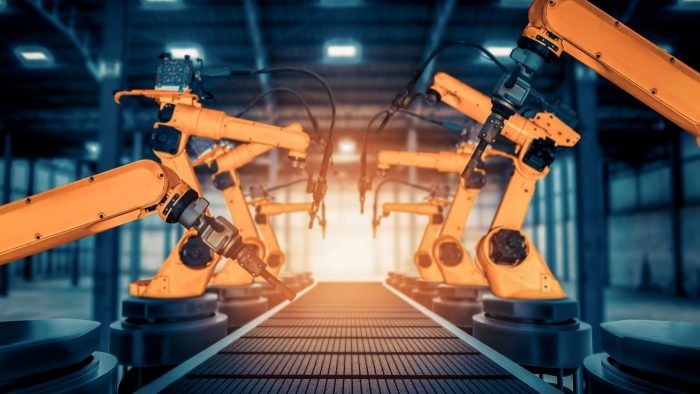
The U.S. manufacturing sector is larger than most people realize, with 17% of world manufacturing value added – more than Japan, Germany, Korea, Italy, and France combined.
Key Takeaways
- Recruitment and retention remain the top concern for U.S. manufacturers, with 481,000 job openings recorded in June alone.
- U.S. robot shipments are projected to expand from roughly 45,000 units in 2025 to 120,000 by 2030, putting the U.S. on track to deploy over one million industrial robots by 2033.
- Global factory automation top-line growth accelerated to 24% year over year in Q2, driving operating profit growth to 56%.
U.S. Manufacturing Labor Shortages & Demographic Trends
With only around 30 million workers in the U.S. manufacturing sector, each employee generates more than $220,000 in manufacturing value added, a figure higher than any other manufacturing economy and more than ten times the equivalent figure in China, Morten Paulsen, head of research and managing director at CLSA Japan, said during a recent webcast.
Despite this strength, the sector faces a structural crisis. Recruitment and retention has been the number one concern among manufacturers for five consecutive years, ranking above inflation, tariffs, and every other operational challenge.
In June alone, there were 481,000 job openings in U.S. manufacturing, even as the industry was emerging from a down cycle, Paulsen said. The demographics make the situation worse: 26% of the manufacturing workforce is aged 55 or older, while only 8% fall in the 16-to-24 age bracket, compared to roughly 13% in other sectors. Additionally, stricter immigration rules are expected to tighten the labor pool further, Paulsen noted.
How Labor Shortages Drive the U.S. Manufacturing Robot Revolution
Research shows a 94% R-squared correlation between manufacturing job openings and robot installations one year later, making labor shortage a reliable leading indicator of robot demand, Paulsen said.
Based on this relationship, robot shipments to the U.S. are forecast to grow from approximately 45,000 to 46,000 units in 2025 to around 120,000 by 2030. By 2033, the U.S. is projected to become the second country in the world to deploy more than one million industrial robots, Paulsen said.
The current upcycle is already showing momentum. The run rate for U.S. manufacturing PMI in 2026 stands closer to 53, up from an average of 49 in 2025. Global factory automation companies reported top-line growth accelerating from 14% in the first quarter to 24% in the second quarter, with operating profit growth jumping from 33% to 56% year over year, according to Paulsen.
While humanoid robots are receiving considerable media attention, a key distinction is often misunderstood. Physical AI – the application of AI tools into the physical world through robotics – is not the same as humanoid robotics. Humanoid deployment in the U.S. is also being slowed by the absence of an ISO safety certification framework, a barrier that is less constraining in China.
Investment Opportunities in the Manufacturing Robot Surge Filling America’s Labor Deficit
For investors, it’s important to understand that labor shortages, far more than policy mandates, remain the fundamental driver behind American automation — and that push is only accelerating.
Paulsen is a strategic advisor for VettaFi’s ROBO Global Indexes, which underpin the ROBO Global Artificial Intelligence ETF (THNQ) and the ROBO Global Robotics and Automation Index ETF (ROBO).
See more: World Bank AI Report Highlights Global Drivers for THNQ ETF
Looking for regular updates? Subscribe here for weekly insights on robotics, AI, and healthcare technology, delivered straight to your inbox.
For more news, information, and analysis, visit the Artificial Intelligence Content Hub.
vettafi.com is owned by VettaFi LLC (“VettaFi”). VettaFi is the index provider for THNQ and ROBO, for which it receives an index licensing fee. However, THNQ and ROBO are not issued, sponsored, endorsed, or sold by VettaFi. VettaFi and its affiliates have no obligation or liability in connection with the issuance, administration, marketing, or trading of THNQ and ROBO.