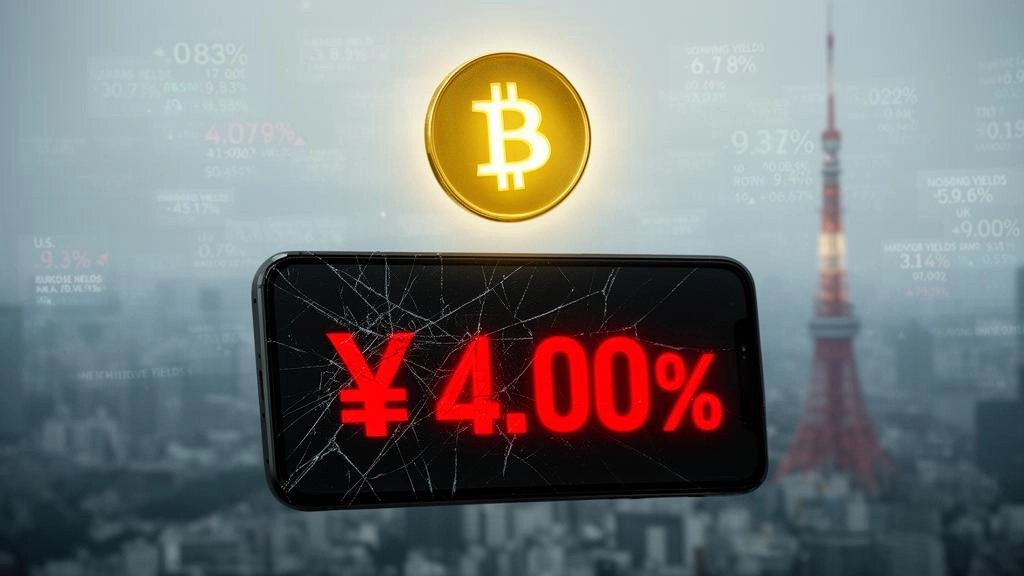
Global financial markets experienced violent turbulence in mid-May, with the epicenter squarely in Japan's government bond market. The yield on Japan's 30-year government bond (JGB) breached the psychological 4% barrier on May 15 for the first time in history, marking its highest level since issuance began in 1999. This is not merely a single-market warning signal but a major indication that the post-war ultra-low interest rate financial system is hitting its limits, drawing comprehensive attention from Wall Street to cryptocurrency markets.
Market analysis points to the Iran war driving up energy prices and reigniting global inflationary pressures as the trigger for this "Japan-style bond crisis." However, the deeper fear lies in the fact that long-term interest rates are skyrocketing despite the Bank of Japan's continued large-scale JGB purchases, signaling that market confidence in Japan's fiscal sustainability is collapsing.
Japan's Bond Market Pricing Logic Upended
For a long time, the Bank of Japan suppressed long-term interest rates at extremely low levels through yield curve control (YCC) and massive asset purchases. But the market structure has now undergone a fundamental shift. On May 15, Japan's 30-year JGB yield surged 13 basis points to 4.035%, the 20-year rose to 3.654%, a high not seen since 1996, and the 10-year touched 2.7%, a 27-year high.
The anomalous phenomenon where rates continue to rise despite the BOJ buying has become the market's most dangerous alarm bell. Li Huihui, a professor of management practice at EMLYON Business School in France, analyzed that Japan is transitioning from a prolonged state of low inflation and low interest rates to a "positive interest rate repricing" phase. Imported inflation is forcing the market to demand a higher term premium, and the Bank of Japan's retreat as the largest buyer has removed the anchor from the bond market.
Japan's corporate goods price index rose 4.9% year-on-year in April, far exceeding expectations, while import prices surged 17.5%. Inflationary pressure is overflowing from upstream, strengthening hawkish voices within the Bank of Japan, with discussions reportedly emerging about a possible rate hike as early as June. However, the rate hike expectation itself is exacerbating bond selling, creating a vicious cycle.
Global Sovereign Bonds Undergo Systemic Repricing
The panic in Japan's bond market is not an isolated event but part of a global sovereign bond sell-off. Around May 15, the U.S. 30-year Treasury yield breached 5% to hit a 10-month high, with the 10-year touching 4.512%. The UK 30-year gilt yield surged past 5.8%, a near 30-year high, while Germany's 10-year bund yield climbed to 3.10%.
Dong Zhongyun, chief economist at China Aviation Securities, pointed to three main reasons for this synchronized global bond rout: First, rising inflation expectations, with the U.S. April CPI rising 3.8% year-on-year, a near three-year high, compounded by Middle East conflict disrupting energy prices. Second, policy uncertainty, as new Federal Reserve Chair Kevin Warsh had just taken office and his "shrink balance sheet for rate cuts" policy framework had not yet been fully digested by the market. Third, chain reactions from cross-market arbitrage trading, with investors from the U.S., UK, and Japan simultaneously reducing their holdings of long-dated bonds.
Vincent Ahn, a portfolio manager at Wisdom Fixed Income, stated bluntly that the repricing of bond markets has effectively stripped the new Fed chair of the option to cut rates. The market is essentially "hiking rates preemptively on behalf of the central bank," making a systemic rise in global borrowing costs a foregone conclusion.
Triple Whammy and the Yen's Erratic Fluctuations
The surge in long-term yields quickly triggered a brutal triple whammy across stocks, bonds, and the yen in Japan. In the equity market, rate-sensitive sectors like real estate and utilities faced valuation pressure. In foreign exchange markets, while the yen saw brief support from rate hike expectations, it remained weak over the medium to long term due to economic fragility, further intensifying imported inflation.
Notably, the yen has exhibited bizarre impulse-style volatility recently. During New York trading hours, the dollar-yen pair has surged 0.5% within two minutes before quickly retreating, a pattern seen multiple times in May. Gareth Berry, a strategist at Macquarie Group, assessed this as "warning shots" from Japan's Ministry of Finance before the exchange rate hits the 160 line, designed to scare off speculators rather than represent large-scale intervention. However, strategists at Sumitomo Mitsui Trust Bank also criticized these piecemeal operations as merely "buying time" and unlikely to reverse the structural weakness.
Bitcoin's Unexpected Inflection Point: From Speculative Asset to Non-Sovereign Store of Value
Amid this sovereign debt crisis, the positioning of cryptocurrency markets has sparked new debate. Analysis charts show that since 2022, the rising trajectory of Japan's ultra-long JGB yields has exhibited a subtle synchronization with Bitcoin's long-term bull trend.
Market observers believe this is no coincidence. As markets realize that "the era of ultra-low rates and massive debt is coming to an end," investors are beginning to reassess assets that do not rely on sovereign credit. In the short term, liquidity tightening and deleveraging will indeed create headwinds for high-risk assets like Bitcoin, leading to sharp sell-offs. However, over the medium to long term, if global investors become convinced that central banks can no longer suppress rates and government debt is approaching its limits, Bitcoin's narrative as a "non-sovereign store of value" could gain unprecedented acceptance.
Faced with severe market turmoil, Japan's Finance Minister reiterated that there is no need to compile a supplementary budget for the time being, attributing the yield rise to global trends. However, the market is not buying this explanation. Japan's government debt is the highest in the world, and raising interest rates would significantly increase fiscal interest payment pressure. Xiang Haoyu, a distinguished research fellow at the Asia-Pacific Institute of the China Institute of International Studies, warned that if the Bank of Japan hikes rates rashly, it could easily suppress fragile domestic demand and impact financial institutions heavily loaded with JGBs.
Currently, Japanese authorities face an almost unsolvable dilemma: without hiking rates, the yen will continue to depreciate, intensifying imported inflation and pushing yields higher. If they hike, it will not only increase the fiscal burden but could also detonate the interest rate risks long concealed within the financial system. This structural fracture in Japan's government bond market is forcing global investors to confront a proposition unseen in the post-war era: the systemic risk of a major sovereign debtor nation losing control over its interest rates.
Once added, BigGo Finance appears first in Google Search Top Stories, so you get the broadest, most up-to-the-minute, and most comprehensive global financial news first.