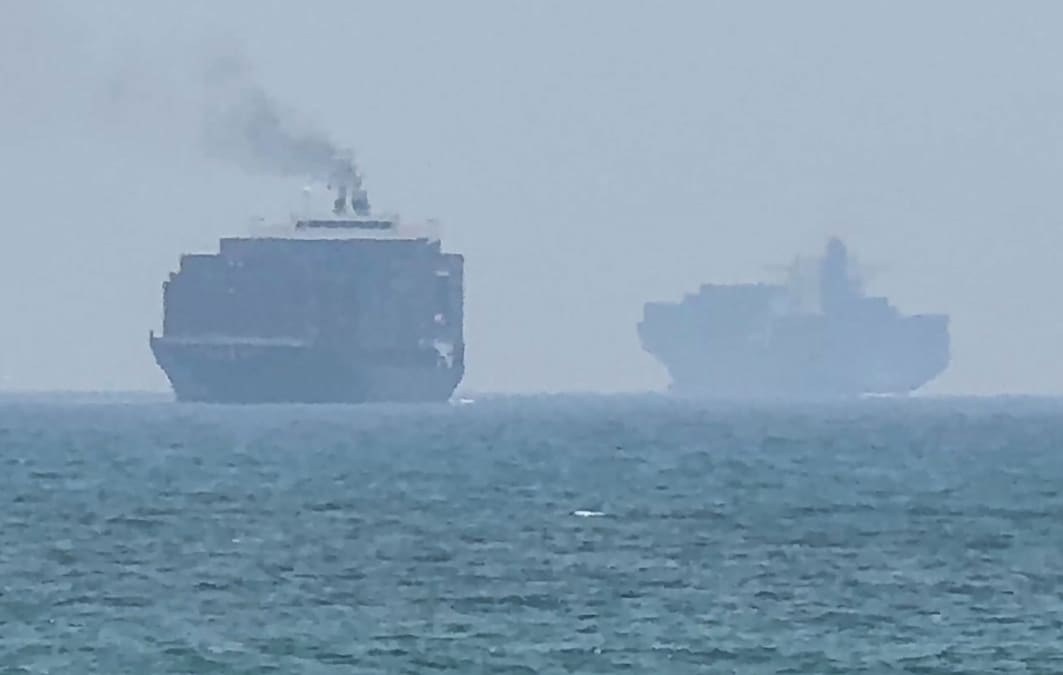
Iran and Oman are in the final stages of drafting an agreement on how to handle commercial shipping in the Strait of Hormuz, Tehran's Foreign Ministry spokesman, Esmail Baghaei, said Wednesday.
That proposed deal would give Tehran more control over vessels passing through the vital oil shipping route, Reuters later reported, citing a senior Iranian source and two regional officials.
Baghaei's remarks at a news conference came hours after President Donald Trump claimed a U.S. deal with Iran to reopen the strait "could happen" as soon as Wednesday or Thursday.
"A lot of progress has been made," Trump told reporters late Tuesday while traveling to Las Vegas. He again claimed Iran is in negotiations with the U.S., despite Tehran's denials.
Trump's predicted time frame for a deal slightly extended the one floated earlier Tuesday by Treasury Scott Bessent, who told CNBC's "Squawk Box" that an agreement could be reached Tuesday or Wednesday.
But Reuters' sources pushed back on Trump's assertions. And Baghaei, in a joint statement with Oman, said Wednesday that the Persian Gulf neighbors have been engaged in their own talks for the past two months "with the aim of determining a safe traffic route for commercial shipping in this strait."
"If some third parties do not obstruct work in this regard, the joint statement of the two countries, including the main considerations and agreed points, is also in the final review and drafting stage," the spokesman said, according to a translation of his remarks.
Baghaei added that Iran and Oman do not have plans to travel to Qatar or Pakistan, where prior attempts at negotiations with the U.S. took place.
The statement appeared to cut against Trump's claims, while raising the prospect that Iran, whose ability to throttle traffic in the strait has been a key source of leverage in its war against the U.S., could forge a deal that further cements its control.
But the Trump administration's latest signals of a forthcoming deal nevertheless drove oil prices sharply lower and sent stocks soaring to record levels as investors anticipated a breakthrough in the five-month war.
In other remarks Tuesday night, Trump once again threatened that Iran will "get hit really hard" if the purported talks fall through.
Crossings through the strait, the pathway for 20% of the world's oil before the U.S.-Iran war's start in February, remain sharply constrained, according to ship-tracking firm Kpler and other sources.
But U.S. Central Command insisted in an X post Tuesday that the "southern route through the Strait of Hormuz remains free and open for all commercial vessels seeking to transit the international waterway."
The southern route passes through Omani territorial waters, rather than the part closer to Iran.
After Bessent's remarks to CNBC, a senior Middle East diplomat with direct knowledge of the talks between Iran and Oman told MS NOW that a great deal of pressure is being brought to bear on Oman by the U.S. and European countries to accept a temporary agreement with Iran to reopen the Strait of Hormuz.
MS NOW also reported that a senior Pakistan government official said a document on reopening the strait is "close to being finalized."
The source, who didn't want to be identified because of the sensitive nature of the topic, added that the talks were being held between Iran and Oman and being mediated by Pakistan — with the U.S involved "indirectly."
U.S. missile shortage
The White House and Pentagon also continue to insist U.S. forces have "more than enough" munitions, after reports that the U.S. military had used "virtually all" of its long-range precision missiles during the Iran war.
Reuters reported the Army has depleted most of its stockpile of Army Tactical Missile Systems and Precision Strike Missiles, and CNN reported that the the U.S. military has exhausted nearly 80% of its interceptors for its THAAD missile defense system, used to defend against ballistic missile strikes.
The White House responded to Reuters with a statement from Trump, claiming the U.S. has "far more munitions than anyone in the world" and "far more than we need."
"Our defense companies were making more munitions than they have ever made before, in addition to expanding their plants and equipment at record levels," Trump said in that statement.