Burnham’s team were clear they want an experienced figure to deliver his vision for UK economy - combining fiscal responsibility with focus on re-industrialisation, devolution, cost of living crisis and driving growth.
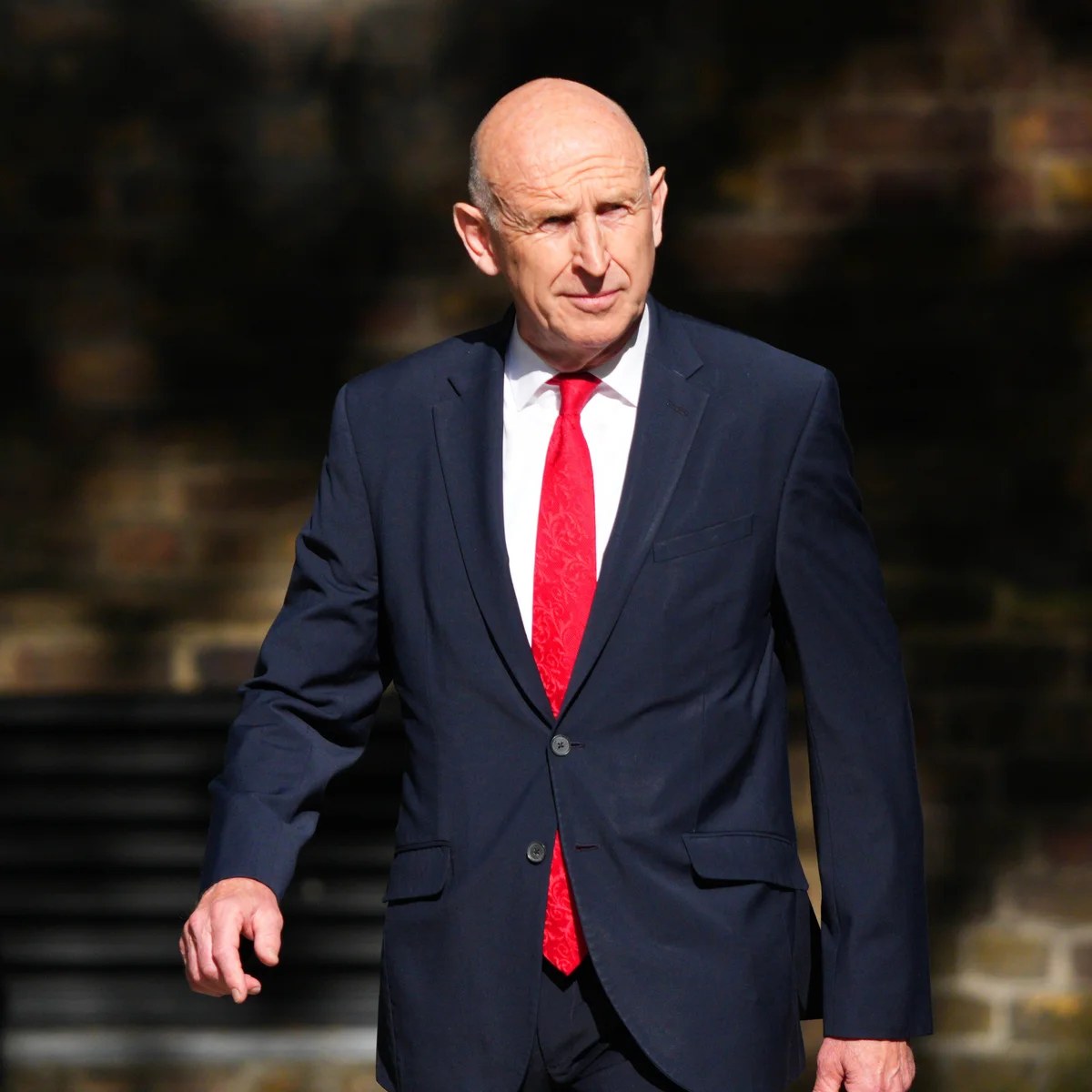
Healey quit cabinet last month accusing Keir Starmer and Rachel Reeves of putting the UK’s security at risk, saying defence investment plan fell well short.
He will now be responsible for finding the money to raise military spending to 3% by 2030. Could he opt for defence bonds to do so - which he argued for from MoD - even though it was dismissed as extra borrowing.
Wes Streeting, the former health secretary, has entered 10 Downing Street. Streeting had been seen as a potential leadership candidate but backed Burnham.
He is joined by the Home Office ministers Angela Eagle and Alex Norris, the former housing minister Miatta Fahnbulleh and the transport secretary, Heidi Alexander.
The new chancellor John Healey said the government led by Andy Burnham “will meet our commitments on defence to our international allies”.
He was asked by broadcasters on Monday night if he would meet a commitment to spend 3% of national economic output on defence by 2030.
Healey expressed frustration that Sir Keir Starmer had not set out a clear timetable for the commitment when he resigned last month as defence secretary.
Asked if welfare cuts or new taxes were on the cards to meet the goal, Healey said: “Fiscal control is the first duty of any chancellor. It is mine. And fiscal credibility is the bedrock for economic stability and for national security.
“You heard the Prime Minister this afternoon say, in this more dangerous world, we will meet our commitments on defence to our international allies.”
Andy Burnham has said his arrival in power will “bring back hope” to Britain as he launched his premiership with the surprise appointment of John Healey as chancellor and a promise to repair the damage caused to communities during the Thatcher era.
The new UK prime minister acknowledged people were “fed up” with politics as he addressed the country after taking over from Keir Starmer in Downing Street, saying the government needed to “do better” to deliver real change.
In his speech outside No 10, he said the government would announce “some breathing space” on Tuesday for people on the cost of living, with plans to cut energy bills and bus fares expected as part of a fully funded package.
Burnham later told reporters that he would look at “any flexibility” within the government’s existing fiscal rules to help borrow billions more to invest in infrastructure – but would take a “very prudent” approach to the economy.
UK 10-year gilt prices dropped after his comments, with the markets already on the edge over the risks of higher borrowing and increased debt. But they had closed by the time that Healey, regarded as a safe pair of hands, was announced.
The former defence secretary, whose resignation pushed Starmer to the brink, emerged as the compromise candidate after Ed Miliband and Shabana Mahmood were tipped for the role. Miliband takes over as foreign secretary while Mahmood remains at the Home Office.
Yvette Cooper said it was a real honour to be appointed Health Secretary by Andy Burnham “27 years after I worked on the first NHS cancer plan as a junior health minister”.
In a statement shared on social media, the former foreign secretary added: “I’m looking forward to working urgently to improve maternity services, to take forward plans for social care, and to once again play a part in supporting our National Health Service, Labour’s proudest achievement.
“Most of all I’m looking forward to working with the dedicated NHS staff, carers, healthcare professionals and volunteers on whom we all depend.
“In leaving the FCDO, let me pay tribute to the brilliant diplomats and ministers I worked with at the Foreign Office, and to my fellow foreign ministers from across the world – for all the work we did together to support Ukraine, to recognise the State of Palestine, to keep the spotlight on Sudan and to treat violence against women and girls as the global crisis it is. The partnerships we build abroad make us stronger at home.”
Ed Miliband said the Foreign Office will be “at the forefront of issues which pose profound and substantial threats to justice and equality in Britain and across the world” under his stewardship.
In a statement shared on social media, he said: “It is a great honour and privilege to have been appointed by the Prime Minister to serve as Foreign Secretary.
“My parents came to Britain as Jewish refugees from the Nazis. To them, Britain was both a sanctuary and a beacon of hope in the global fight against fascism. I will carry my parents’ faith in that spirit of Britain to my role representing our country.
“I will be a Foreign Secretary who fights for Britain’s interests and our values of democracy, freedom and the rule of law on the world stage.”
He promised to maintain close ties with both the EU and the United States, as well as upholding Britain’s commitments to Nato and the United Nations. Miliband added: “The FCDO (Foreign, Commonwealth and Development Office) I lead will also be at the forefront of issues which pose profound and substantial threats to justice and equality in Britain and across the world.
“We will work with others on tackling the climate crisis, strengthening our partnerships for international development, and reforming our international institutions so they deliver for all countries, including the world’s poorest people.”
Reacting to the news, Jean McLean, chief influencing officer at charity Oxfam GB, said: “Ed Miliband takes on the role of Foreign Secretary at a defining moment for Britain and the world. Across the globe, crises are deepening. From the Democratic Republic of Congo to South Sudan, communities are facing infectious disease, conflict, hunger and climate shocks, with millions trapped in prolonged emergencies that rarely make the headlines but continue to destroy lives.
“These crises are not inevitable. They are often the result of political choices and a failure of leadership.
“Last week’s announcement of cuts of up to 90% to UK aid in parts of Africa risks taking a wrecking ball to Britain’s global leadership. It will not make the UK safer, and it will not reduce inequality at home or abroad. You don’t build security by walking away from insecurity.
“This is a real moment to be better. Restoring the aid budget to 0.7% of GNI must be central to rebuilding Britain’s global leadership”.
Yvette Cooper has been appointed health secretary.
Meanwhile, Pat McFadden will remain in his role as work and pensions secretary.
Cooper, the former foreign secretary, left Downing Street a few minutes ago with McFadden.
Ed Miliband was earlier named foreign secretary.
That’s all from me, Tom Ambrose, on this whirlwind of a day in Westminster. There are still a number of appointments to be made this evening, so stay with the blog as my colleague Nadeem Badshah sees you through.
Burnham’s first Labour cabinet: who’s in and who’s out?
Andy Burnham has appointed his first cabinet, with the new prime minister rewarding those who have been loyal to his takeover efforts.
He had promised to pick his top team from all wings of the party in an effort to show he is trying to run a more inclusive administration.
But at the same time, his decision to have a brutal clearout of Starmer allies resulted in many considered to be on the right of the party or close to the former prime minister losing their jobs.
In goes education secretary Bridget Phillipson and Burnham ally Lucy Powell.
There really are quite a few inside No 10 at the moment. It feels inevitable that a slew of appointments are going to be announced at the same time shortly.