- Published
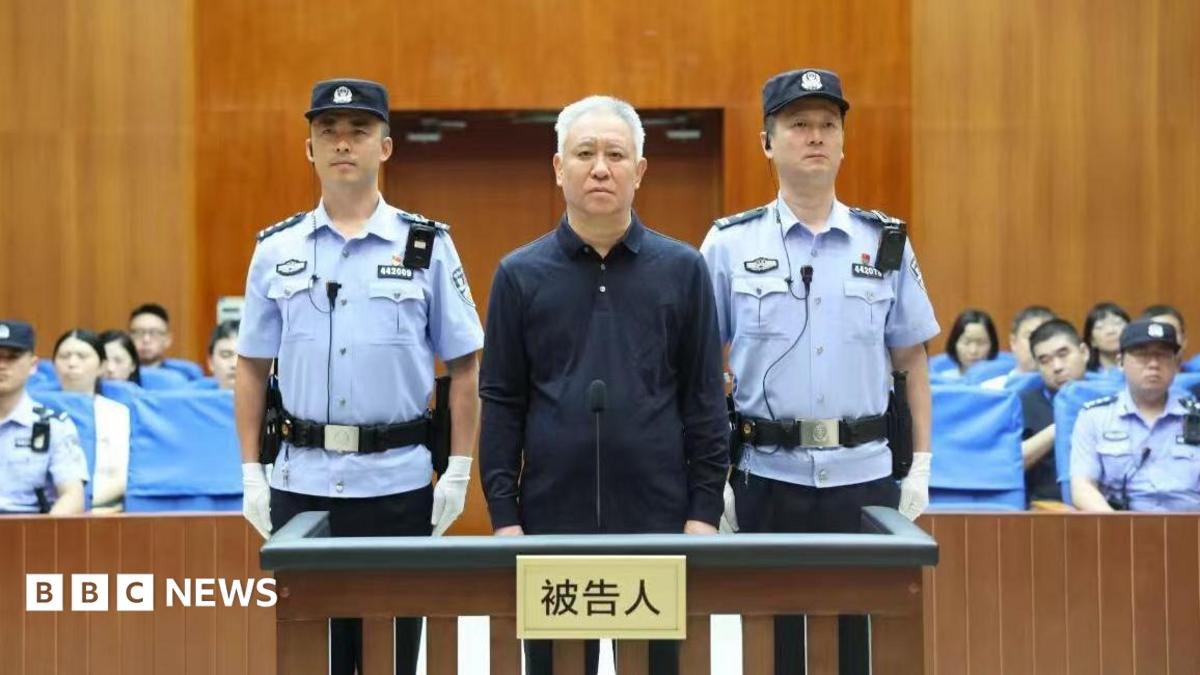
The founder of Evergrande, the property giant at the centre of China's housing market slump, has been sentenced to life in prison and had all of his personal property confiscated.
Hui Ka Yan pleaded guilty in April to several charges, including embezzlement of assets and corporate bribery.
Shenzhen Intermediate People's Court also fined his former companies a total of 15.82bn yuan (£1.73bn; $2.35bn) over multiple crimes, including falsifying records and concealing debt.
Hui's sentencing marks a key moment in the fallout from Evergrande's collapse, which shook China's property sector and hit investors and domestic banks hard.
Hui and his businesses "seriously disrupted" the Chinese property market, resulting in significant economic losses, the court said.
Other Evergrande executives, including Hui's two sons Xu Zhijian and Xu Tenghe, were also sentenced to jail terms ranging from 22 months to 18 years, according to state media.
Once ranked Asia's richest man, Hui has seen his wealth and influence dwindle as his company unravelled.
Hui, also known as Xu Jiayin, rose from humble beginnings in rural China, where he was raised by his grandmother before venturing into property development and setting up Evergrande in 1996.
He oversaw the company's rapid rise through an aggressive expansion programme funded with large amounts of borrowed money.
Evergrande became China's biggest real estate developer, with a stock market valuation of more than $50bn (£36.7bn). Hui was once estimated to be Asia's richest person.
-
Evergrande: Why should I care about the crisis-hit Chinese property giant?
- Published25 August 2025
-
Anxious Chinese home buyers reel from Evergrande crisis
- Published29 September 2023
-
Crisis-hit China Evergrande ordered to liquidate
- Published29 January 2024
The firm was dealt a huge blow when Beijing introduced measures in 2020 to control debt in the country's property sector.
As the company struggled to meet interest payments on its debts it sold properties at huge discounts to stay afloat before collapsing in 2021.
In April, the court heard that the company had taken millions of dollars in pre-sale funding from potential house buyers that were not used for construction.
The money had instead been channelled to new property developments, resulting in hundreds of unfinished projects.
In March 2024, Hui was fined $6.5m and banned from China's capital market for life for his company overstating its revenue by $78bn.
Evergrande's stock market valuation shrank by 99% before its shares were removed from the Hong Kong exchange in August 2025 after more than a decade and a half of trading.
Evergrande's implosion has often been blamed for triggering a broader slump in China's property market that continues to weigh heavily on the economy.
At its height, Evergrande was the biggest firm in the country's real estate industry, which made up about a third of China's gross domestic product at the time.
The property market was a significant driver of growth and an important revenue source for local governments.
The industry's ongoing problems have weighed heavily on the world's second largest economy as several other major developers faced financial woes.