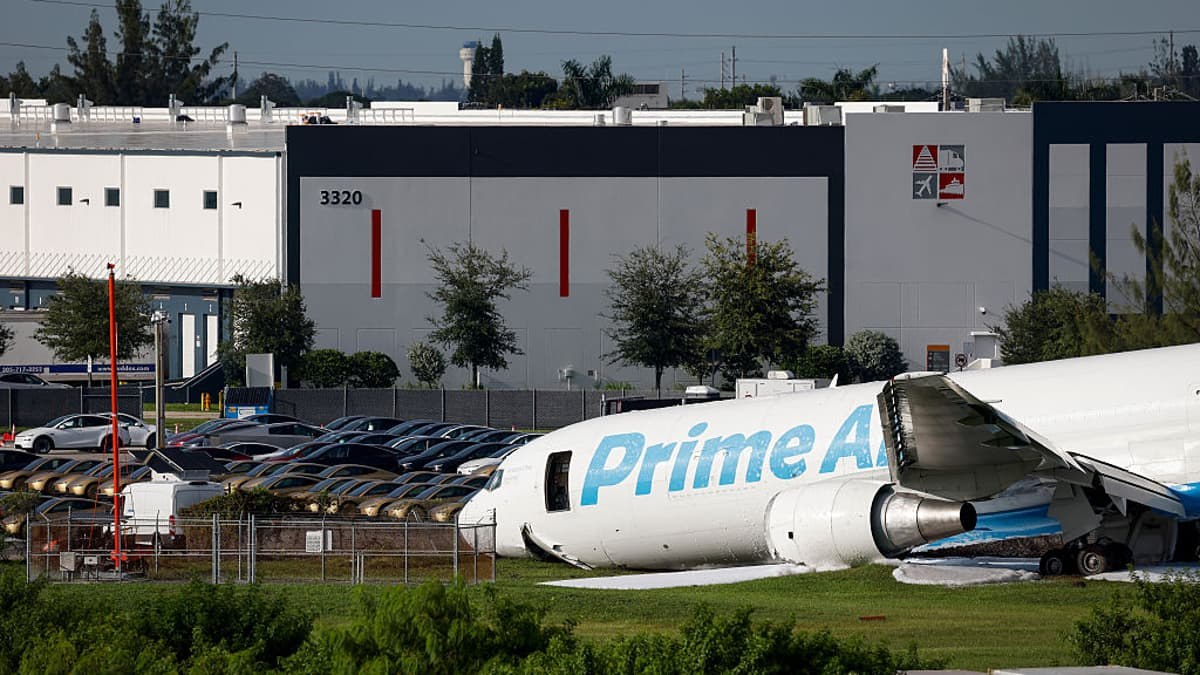
At least 5 dead after Amazon cargo plane barreled off runway at Miami airport
MIAMI (AP) — An Amazon cargo plane barreled off a runway at Miami International Airport on Sunday, killing at least five people and injuring five others as it struck vehicles and was engulfed in flames, authorities said.
The aircraft overran the runway around 2 p.m. after arriving from San Juan, Puerto Rico, and plowed across a road used by warehouse workers and other businesses that surround the airport. Five people were killed, three critically injured and two others hospitalized with less severe injuries, Miami-Dade County officials told a news conference.
It wasn’t immediately clear if the pilots survived or those killed were all in vehicles when the plane struck.
The crash, which sent thick black smoke billowing into the sky, trapped the pilot and copilot in the cockpit and some occupants in cars, said Miami-Dade Rescue Fire Chief Ray Jadallah. The agency said crews also had to extricate a person who was trapped under a vehicle.
The crash halted flights at the busy travel hub for much of the afternoon. Some 200 emergency personnel responded, finding the plane with heavy flames and smoke from a complex engine compartment fire, the department said. Firefighters used foam from specialized airport firefighting units to extinguish the fire, and crews were still dealing with a fuel leak on the plane hours later.
The Prime Air plane came to rest beside a roadway near two semitrucks, images showed. The aircraft appeared to be resting on its belly and was largely intact despite the fire.
The cause had yet to be determined, and it was not clear if weather had played a role. Thunderstorms and wind gusts up to 30 mph (48 kph) were recorded in the area at the time, according to the National Weather Service.
The flight had been operated by 21 Air, a cargo carrier based in North Carolina. The 32-year-old Boeing 767 was originally built to carry passengers and flew for several airlines for more than two decades before being converted to a cargo plane in 2015, according to flight-tracking site Flightradar24.
More than 160 flights were canceled and nearly 325 delayed by late Sunday, according to FlightAware, a website that tracks flight disruptions. Officials from Orlando International Airport, more than 200 miles (320 km) north of Miami, said some flights were diverted there.
The National Transportation Safety Board said it was sending a team to Miami led by Chairwoman Jennifer Homendy to investigate.
Amazon said in a statement that it would cooperate with any investigation.
“We’re heartbroken to learn that five people lost their lives in today’s incident at Miami International Airport,” the company said. “Our deepest sympathies go out to the families, loved ones, and all those affected by this devastating loss.”
Last year, a UPS plane crashed after losing its engine while accelerating down the runway at Louisville’s Muhammad Ali International Airport. The crash killed all three pilots and 12 people on the ground. Twenty-three more were injured.
Aviation safety expert Steve Arroyo said that a 767 cargo aircraft would typically be staffed only by a pilot and copilot on domestic flights. A third pilot would be added for an international flight, and a long-haul international flight would require a fourth pilot.
Arroyo, a retired longtime United Airlines pilot, said he wants to know whether the Amazon plane landed in the touchdown zone of the runway, and if it was beyond that area why it didn’t simply abort that landing and go around to line up for another attempt. Typically, the landing zone is within the first 3,000 feet (914 meters) of a runway.
“Did the aircraft land within the required touchdown zone?” he asked. “If it did, what happened?”
Mary Schiavo, who is a pilot and former inspector general of the Transportation Department, said that video posted online of the landing shows the Amazon plane floating above the runway for an extended period without flaring the nose upward to force the main landing gear onto the ground.
“It didn’t touch down right away, and so it lost a lot of critical real estate by just continuing to float over the runway. It was literally still flying,” Schiavo said.
She noted the Miami airport is not equipped with arresting systems that the FAA says have been installed at more than 120 airports nationwide to safely stop planes that do go past the end of a runway. Those beds of lightweight, crushable material at the end of a runway have been credited by the FAA with helping save at least 497 lives aboard planes that overran runways.
Funk reported from Omaha, Nebraska. Associated Press writers Tim Reynolds in Miami, Rio Yamat in Las Vegas and Wufei Yu in Phoenix contributed.