Moneywise and Yahoo Finance LLC may earn commission or revenue through links in the content below.
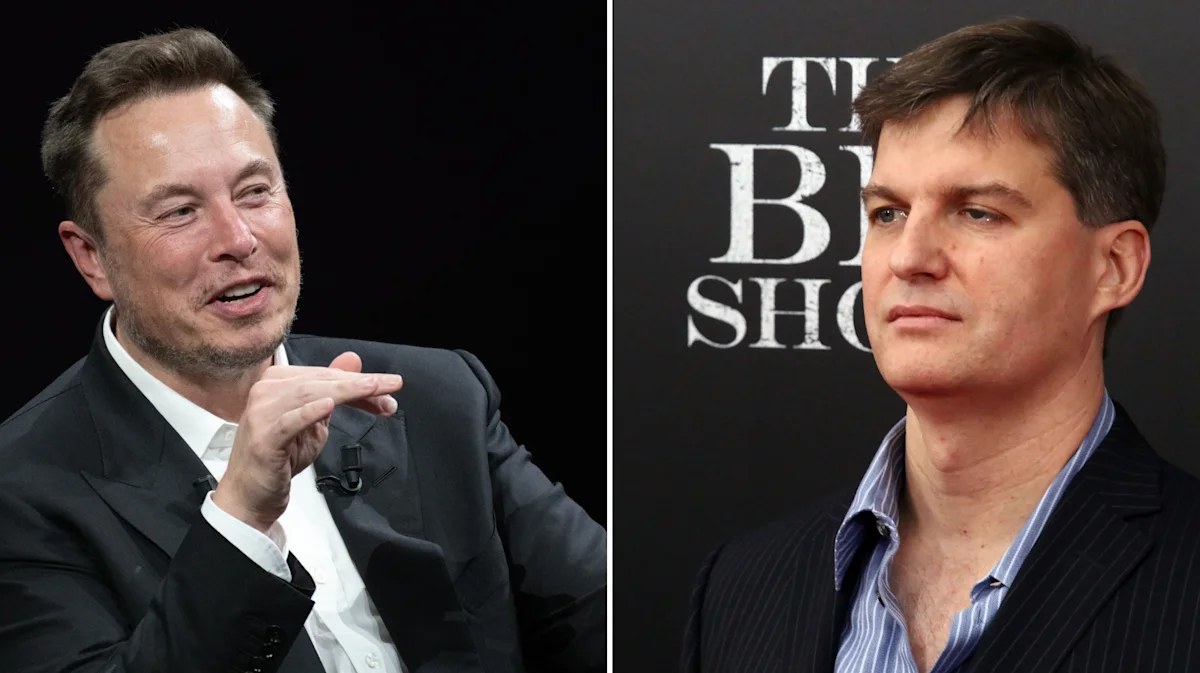
SpaceX's stock-market debut temporarily minted CEO Elon Musk as the world's first trillionaire, but not everyone is convinced of the company's valuation. Among the skeptics is famed investor Michael Burry, who recently revealed that he is choosing neither to buy in nor to wager against SpaceX, despite his skepticism.
In a post on Substack (1), the investor, best known for predicting the U.S. housing collapse before the financial crisis, said he examined several options trades betting against the rocket-and-AI company, but has decided to pass.
Top Picks
Put options are among the most common ways investors bet against a stock. They give the holder the right to sell shares at a predetermined price, called the strike price, before a set expiration date. If the stock falls below that level, the investor profits.
Burry says a put option with a $100 strike price expiring in December 2028 was trading at approximately $25. Similar contracts expiring in June 2027 and December 2026 were priced around $13 and $6.75, respectively.
"Tempted by that one. But no thank you," Burry said of the December 2026 option, adding that "with any luck," SpaceX stock will settle somewhere in the mid-$200s.
SpaceX's stock was trading between $190 and $200 per share following its highly anticipated debut on June 12. If Burry were to buy put options with a $100 strike price, he'd be betting that the stock would fall below $100 — a drop of more than 50%.
Despite his reputation for bearish (2), or pessimistic, investing, Burry emphasized that he currently has no position in SpaceX.
"I am not involved with SpaceX now. Neither short nor, ahem, long," he said.
The investor is no stranger to betting against popular companies (3). A regulatory filing from November revealed the billionaire's hedge fund purchased five million put options on Palantir, a surveillance tech company that has had an incredible run on the stock market, and one million on giant computer chip manufacturer Nvidia, among others.
The risks of betting against Musk
SpaceX's highly anticipated IPO may have started with a bang, but the excitement didn't last long. Shares jumped more than 50% above the $135 debut price as investors rushed to get a piece of one of the most talked-about companies on Wall Street.
But the momentum quickly faded. By the end of last week, many investors who bought into the early excitement had watched nearly all of those initial gains disappear. SpaceX shares fell about 12% over the past week and are now roughly 28% below their June 16 peak (7).
Still, despite the pullback, investors betting against the company remain relatively cautious. Short interest currently stands at around 40 million shares, representing an estimated 5% to 7% of SpaceX's publicly tradable shares, according to S3 Partners.
"SPCX has attracted active short-selling interest, but the data suggest this is far from a supply-constrained short," Matthew Unterman, head of research at S3, said in an interview with CNBC (8), adding, "The current setup looks more like normal price discovery than a classic short-squeeze candidate."
Read More: Thanks to Jeff Bezos, you can become a landlord for $100 — without the headache of actually being one
Debate over SpaceX's valuation
Burry hasn't just decided to pass on wagers against SpaceX. He's also calling into question its nearly $3-trillion market valuation, calling it "fundamentally a small space company."
Burry argues the company is still too niche to be able to dwarf many established businesses, fortunes and national economies, pointing out that it still generates less than $20 billion in annual revenue (4).
"With that $2.8 trillion, SpaceX's market cap could buy Page, Brin, Bezos, Zuckerberg, Ellison, Arnault, Huang, Buffett, and Ortega and still have $1 trillion left over," Burry said, naming off a cadre of billionaires.
SpaceX debuted with an IPO priced at $135 a share (5). It sold more than 555 million shares to raise roughly $75 billion, making it the largest IPO in history.
Burry isn't alone in his concern about SpaceX's valuation. There has been heated debate over whether the company is overvalued.
Musk, however, doesn't seem too concerned. In a post on X (6), he said he believes SpaceX could generate $1 trillion of revenue in 2030.
Echoes of the dot-com bubble
Burry's skepticism extends beyond SpaceX. He has previously warned the rapid rise of artificial intelligence-related stocks bears similarities to the dot-com bubble of 1999 and 2000. He argues that many technology companies are being driven too aggressively by investor excitement and public momentum.
According to Burry, stock prices have become increasingly disconnected from traditional indicators such as economic data and consumer sentiment. That environment, he believes, creates the potential for sharp corrections.
Choose your investments wisely
SpaceX's IPO was a reminder of just how quickly market excitement can build — and how quickly it can disappear.
That's why chasing the latest market trend can be risky. Instead of buying simply because everyone else is talking about a company, you may want to focus on finding businesses with strong fundamentals trading at fair prices.
That's the approach legendary investor Warren Buffett has followed throughout his career.
"It's far better to buy a wonderful company at a fair price than a fair company at a wonderful price," legendary investor Warren Buffett said in Berkshire Hathaway's 1989 shareholder letter (8).
Of course, identifying those opportunities isn't always easy.
Get expert advice
Markets move quickly, and keeping up with earnings reports, industry trends, and economic data can feel like a full-time job.
That's where platforms like Moby come in.
Their team of former hedge fund analysts and experts spends hundreds of hours each week sifting through financial news and data to provide you with breaking stock recommendations.
Moby's success speaks for itself. The platform's stock picks have outperformed the S&P 500 index by about 11.9% over the past four years.
Even better, Moby offers a 30-day money-back guarantee so you can see if the service is right for you.
And if you sign up for Moby Premium you get one free top-stock.
Diversify with a safe-haven asset
The rise and fall of SpaceX shares highlights just how quickly investor sentiment can shift.
And the shift hasn't been limited to SpaceX. Investors have become more cautious about whether some AI-related companies can continue justifying their massive valuations.
Magnificent Seven companies, along with Broadcom and Oracle, have lost roughly $2.7 trillion in market value in June, according to Yahoo Finance (9).
Building a diversified portfolio often means including assets that can behave differently when stocks are under pressure. Gold has historically played that role, typically serving as a hedge during periods of uncertainty and market turbulence.
Open a gold IRA
Opening a gold IRA with the help of Goldco allows you to invest in gold and other precious metals in physical forms while also providing the significant tax advantages of an IRA.
With a minimum purchase of $10,000, Goldco offers free shipping and access to a library of retirement resources. Plus, the company will match up to 10% of qualified purchases in free silver.
If you're curious whether this is the right investment to diversify your portfolio, you can download your free gold and silver information guide today.
Real estate can add another layer of protection
When markets become dominated by hype — whether it's space technology, AI, or another major trend — having assets outside the stock market can help reduce portfolio swings.
Real estate is one option that can help spread risk beyond stocks. Unlike shares, property values aren't constantly changing based on daily investor sentiment, which can make real estate an attractive option. Even better? You can earn passive income through rent.
Of course, investing in real estate isn't without challenges.
Being a landlord involves much more than simply collecting rent. You have to think about mortgage payments, insurance, maintenance, repairs, and the possibility of dealing with difficult tenants.
The good news? There are ways to invest in real estate without becoming a hands-on landlord.
You can invest in shares of vacation and rental properties across the country with Arrived.
Backed by world-class investors like Jeff Bezos, Arrived's team handles all the necessary work — from securing properties to finding and managing tenants — so you can sit back and become a landlord without having to do any legwork.
Even better, Arrived distributes any rental income generated by properties to investors monthly, allowing you to potentially set up a passive income stream.
To get started, simply browse through their selection of vetted properties, each picked for their potential appreciation and income generation.
The best part? For a limited time, when you open an account and add $1,000 or more, Arrived will credit your account with a 1% match.
A finer asset billionaires love
SpaceX's rise and fall also highlight why some of the world's wealthiest investors don't rely on one type of asset to build and preserve wealth.
While billionaires like Jeff Bezos and Bill Gates built much of their wealth through equities, their portfolios extend well beyond the stock market. Their portfolios also contain assets that don't always follow the same ups and downs as the broader market.
Fine art is one example that has gained popularity among ultra-wealthy investors.
High-net-worth individuals allocated about 20% of their portfolios to fine art in 2025, up from 15% a year earlier. Among those with more than $50 million in wealth, the share climbed to 28% (10).
The appeal isn't just diversification. The asset outpaced the S&P 500 by 15% from 1995 to 2025 while showing near-zero correlation to traditional equities.
Until recently, this world was off-limits to most everyday investors. Now, with Masterworks, you can buy fractional shares in multimillion-dollar works by icons like Banksy, Picasso and Basquiat. While art can be illiquid and typically requires a long-term hold, it offers unique portfolio diversification.
Masterworks has sold 27 artworks so far, yielding net annualized returns like 14.6%, 17.6% and 17.8%.
Moneywise readers can get priority access to diversify with art: Skip the waitlist here.
Note that past performance is not indicative of future returns. Investing involves risk. See important Regulation A disclosures at Masterworks.com/cd.
You May Also Like
Join 250,000+ readers and get Moneywise's best stories and exclusive interviews first — clear insights curated and delivered weekly. Subscribe now.
Article Sources
We rely only on vetted sources and credible third-party reporting. For details, see our ethics and guidelines.
CNBC (1), (5), (8); Investopedia (2); Yahoo Finance (3), (4); @JohnErlichman/ X (6); Berkshire Hathaway (7); Yahoo Finance (9); The Art Basel & UBS (10)
This article provides information only and should not be construed as advice. It is provided without warranty of any kind.