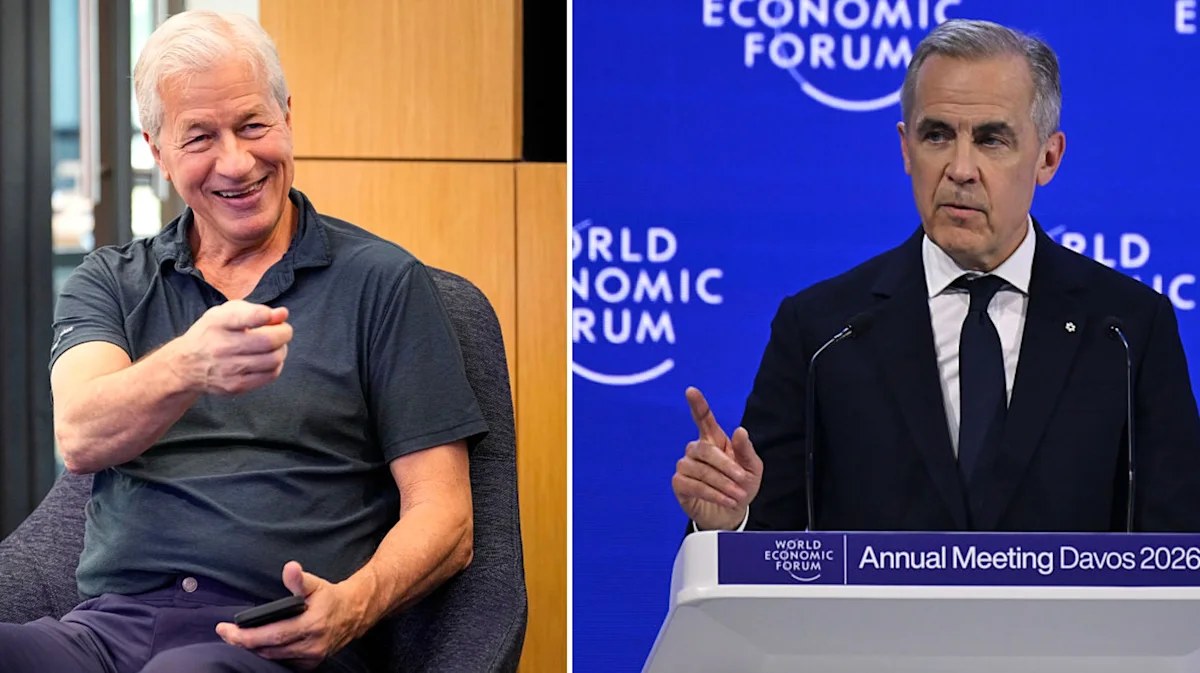
Jamie Dimon doesn't think Canadian Prime Minister Mark Carney's vision for a coalition of middle powers is grounded in economic reality.
Speaking during the Council on Foreign Relations' CEO Speaker Series (1), the JPMorgan Chase CEO drew laughs after dismissing Carney's proposal that countries should work more closely together to counter growing pressure from global superpowers.
"When Mark Carney said the powers should get together, it's a fantasy," Dimon said.
Earlier in 2026, former Bank of Canada and Bank of England governor Carney first outlined the strategy (2) during the World Economic Forum Annual Meeting in Davos, Switzerland, where he argued that middle powers should deepen cooperation on trade, artificial intelligence, critical minerals, supply chains and security as the decades-old U.S.-led world order becomes increasingly fragmented.
Dimon argued Europe already offers a real-world example of why that approach falls short.
"They did that. It's called Europe," he said, pointing to what he sees as the continent's declining economic competitiveness.
"The GDP of Europe has gone from 90% of America to 70%," Dimon said. "And in our view, it will probably continue to erode over time because of high taxes."
World Bank data (3) broadly support the comparison. In 2024, the European Union generated roughly $19.5 trillion in GDP, compared with nearly $28.8 trillion for the U.S.
Dimon says growth matters more than alliances
Carney has argued that closer cooperation would give middle powers more leverage against tariffs, supply chain disruptions and economic coercion by larger nations.
Dimon countered that cooperation alone isn't enough if governments fail to create an attractive environment for businesses and investors.
While he stated he wasn't against social safety nets, he argued that in Europe, "This is a serious problem (1)."
He argued that high taxes, burdensome regulation and weak capital formation have slowed growth while leaving many European governments carrying debt loads approaching 100% of GDP.
Dimon also contrasted the size of U.S. capital markets with Europe's, arguing that America's larger stock market reflects policies that have encouraged investment and economic expansion.
Rather than building new geopolitical blocs, he suggested Europe should focus on creating a true common market with policies designed to stimulate growth.
"Have a real European Union, open trade services to everyone in there, have a big common market, have a growth strategy and policies that can drive growth," he said.
Build a portfolio that can weather uncertainty
Whether Dimon or Carney ultimately proves right, investors have little control over government policy, trade negotiations or the future of the global economy.
What they can control is how diversified their own portfolios are.
Periods of geopolitical uncertainty often remind investors of the importance of owning assets that don't all respond the same way to economic shocks.
Here are a few ideas for you to take control of your own portfolio through diversifying your assets.
Relying on government or global alliances for your financial security is, at best, a gamble.
Instead of waiting on policy, many investors are taking control by diversifying into assets such as precious metals. Gold has historically been viewed as a reliable store of value during the very periods of geopolitical uncertainty and economic erosion that Dimon and Carney are debating.
If you're curious about adding precious metals to your broader investing strategy, a gold IRA from Goldco lets you hold physical gold and other metals while still getting the tax advantages of an IRA.
Goldco is widely regarded as one of the leading companies in the space, with a 4.8/5 rating on Trustpilot and an A+ from the Better Business Bureau. They also offer a guaranteed buyback program, meaning they'll repurchase your metals at the highest price according to market value if you ever decide to sell.
So, if you want to explore whether precious metals could be a helpful hedge for your portfolio, you can download Goldco's free gold and silver guide to see if it's a good fit for you.
Beyond protecting your wealth against the economic uncertainty Dimon and Carney are debating, true financial control often requires adding tangible, income-generating assets to your portfolio.
Rental properties have long been a proven source of steady, passive income for high-net-worth investors. Amongst high-net-worth individuals, investment real estate accounts for 42% of overall alternative asset allocation, according to a report by Long Angle (4).
However, the time, effort and costs involved in managing and maintaining multiple properties prevent many from investing. So, unless you're a hedge fund titan or an oil baron, you've likely been shut out of one of the most profitable corners of the market.
That's where mogul comes in. This real estate investment platform offers fractional ownership in blue-chip rental properties, which provides investors with monthly rental income, real-time appreciation and tax benefits — without the need for a hefty down payment or late-night tenant calls.
Founded by former Goldman Sachs real estate investors, the mogul team handpicks the top 1% of single-family rental homes nationwide for you. Simply put, you can invest in institutional-quality offerings for a fraction of the usual cost.
Each property undergoes a vetting process that requires a minimum 12% return, even in downside scenarios. Across the board, the platform features an average annual IRR of 18.8%. Their cash-on-cash yields, meanwhile, average between 10% to 12% annually.Offerings often sell out in under three hours, with investments typically ranging between $15,000 and $40,000 per property.
Every investment is also secured by real assets, not dependent on the platform's viability. Moreover, each property is held in a standalone Propco LLC, so investors own the property — not the platform. Blockchain-based fractionalization adds a layer of safety, ensuring a permanent, verifiable record of each stake.
Getting started is quick and easy. You can sign up for an account and then browse available properties. Once you verify your information with their team, you can invest like a mogul in just a few clicks.
Invest in assets that perform independently of policy
If relying on global coalitions is, as Dimon suggests, a fantasy, then relying exclusively on traditional markets might not be the soundest strategy. Smart money often seeks assets that simply don't react to geopolitical disputes, let alone to broader market movements.
For example, art doesn't care about tariffs, trade wars or supply chain bottlenecks.
While billionaire investors have long carved out a slice of their portfolios in post-war and contemporary art to hedge against market volatility, this asset class was once reserved for the ultrawealthy.
Masterworks changes that by offering fractional ownership in works by world-renowned artists like Banksy, Basquiat and Picasso, making art accessible to everyone.
Masterworks has sold 27 artworks so far, yielding net annualized returns like 14.6%, 17.6% and 17.8%.*
Moneywise readers can get priority access to diversify with art: Skip the waitlist here.
*Past performance is not indicative of future returns. Investing involves risk. See important Regulation A disclosures at Masterworks.com/cd
If you're unsure whether your investments are positioned for an increasingly uncertain economic environment, working with a financial advisor can help.
Having an advisor at your side can be especially important for investors with portfolios of $250,000 or more, as their financial decisions often become increasingly nuanced. Managing withdrawals, minimizing tax exposure and ensuring long-term sustainability often requires greater coordination and strategic planning.
In a nutshell, working with a financial advisor can help reduce the chance of making costly mistakes.
So, if you have a portfolio of $250,000 or more, platforms like WiserAdvisor can connect you with vetted professionals who specialize in this kind of planning.
Simply answer a few questions about your savings, retirement timeline and overall investment portfolio. From there, WiserAdvisor reviews its network to match you — for free — with up to three vetted, reputable advisors aligned with your specific needs.
WiserAdvisor is a matching service and does not provide financial advice directly. All matched advisors are third parties, and specific financial results are not guaranteed.
We rely only on vetted sources and credible third-party reporting. For details, see our ethics and guidelines.
YouTube (1); YouTube (2); World Bank (3); Longangle (4)
This article provides information only and should not be construed as advice. It is provided without warranty of any kind.