Two Federal Reserve presidents on Friday said interest rates will need to move higher to rein in inflation.
The St. Louis Fed's Alberto Musalem said another rate hike will need to happen soon. And Lorie Logan of the Dallas Fed predicted that the central bank will need to raise rates by quarter-point increments at least two more times.
The comments from the two officials offer the first morsels of insight into what leaders at the Fed see next after the central bank on Wednesday elected to leave rates unchanged for now. The remarks are likely to bolster the view among investors that the Federal Open Market Committee will return to hiking rates at its next meeting in December.
Fed funds futures traders are pricing in a roughly 76% likelihood of the Fed lifting rates by a quarter percentage point at that gathering, according to CME's FedWatch tool.
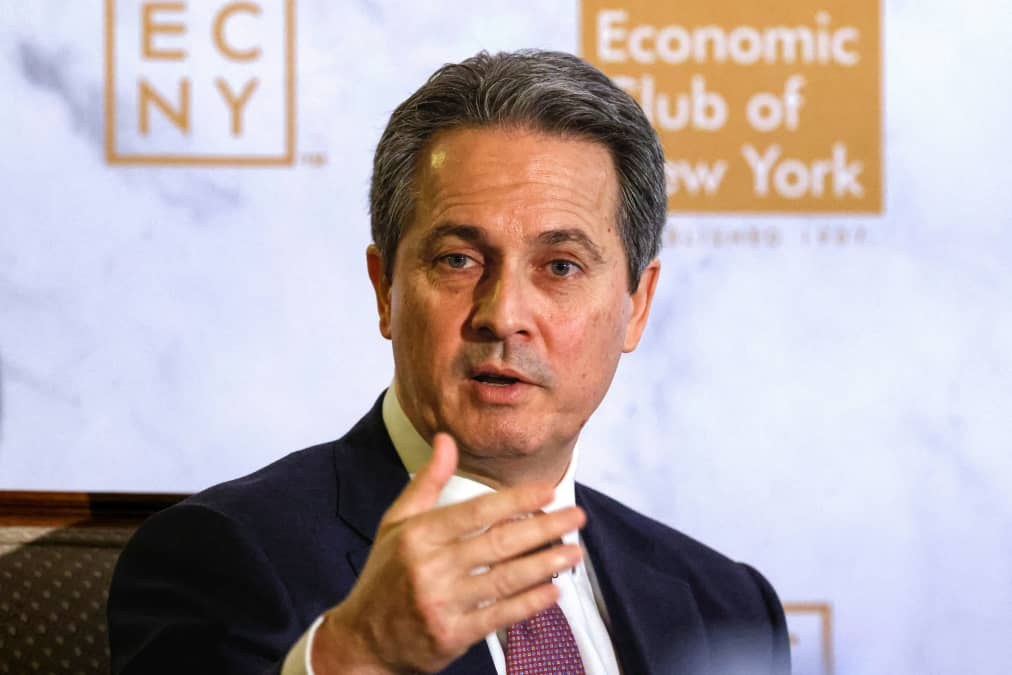
"I judge that additional firming of monetary policy will be necessary, and soon," Musalem said in prepared remarks for the Shadow Open Market Committee, a gathering of economists in New York focused on the central bank.
"Incremental adjustments made earlier are usually less disruptive than larger and abrupt actions taken later," Musalem said. "Moving sooner in smaller steps while inflation expectations are anchored has a better chance of succeeding without adverse impact on the labor market or economic growth."
In remarks roughly an hour later, Logan said: "It remains clear to me, given the current outlook, that the FOMC needs to implement at least two more 25-basis-point rate increases."
Still, she said, that doesn't mean the Fed has to raise rates at every meeting.
"Skipping a meeting does not change the monetary policy destination," Logan told students at Davidson College in North Carolina, according to her prepared remarks. "Indeed, by making the destination clear, the FOMC can better help the economy adapt and obtain the promised benefits of a skip."
After the predicted two rate hikes, Logan said, "it would make sense in my view to pause and examine economic and financial developments to determine what further action may be appropriate."
Logan will be among the Fed officials voting on the rate decision in December; Musalem is slated to be a non-voting member of the committee until 2028.
Inflation is 'too high'
In his remarks, Musalem broadly spoke positively about the state of the U.S. economy, which he described as "resilient." He pointed to Thursday's data on U.S. GDP, which showed a stronger-than-expected growth rate of 3.4%.
He said there are several factors boosting the economy, including the artificial-intelligence buildout and financial conditions that "remain accommodative."
Musalem said the labor market has been "remarkably stable and balanced." The unemployment rate of 4.2% sits at the median of long-run projections by participants in the Federal Open Market Committee, the group tasked with setting interest rates, he noted. Musalem is not a voting member of the FOMC this year, and isn't expected to have a vote until 2028.
But Musalem warned that inflation is "too high," citing the personal consumption expenditures price index released Thursday that showed annual inflation above 3%. In the question-and-answer portion of the event, Musalem said he's watching core inflation closely, and is on alert for any indications that current inflationary pressures are broadening out.
Fed officials have been closely monitoring inflation expectations among consumers and investors to ensure they don't get too far above the central bank's long-term target of 2%.
Musalem said there's a likely scenario where inflation remains above 2% into the future unless the Fed adjusts monetary policy.
"The best that monetary policy can do now for employment and economic growth is to restore price stability in a timely manner," Musalem said. "The short-run economic costs of reducing inflation are less when the central bank acts before inflation has become entrenched and is expected to persist."
Two of the 12 FOMC voters dissented from Wednesday's decision to keep rates unchanged – Governor Lisa Cook and Cleveland Fed President Beth Hammack – both of whom wanted the committee to raise rates by a quarter percentage point.
Former Fed officials weigh in
Speaking on CNBC Friday, former Richmond Fed President Jeffrey Lacker said he too would have been in favor of a rate hike this week.
"I've been surprised by the lack of urgency. Inflation's been high around three, three-and-a-half percent for so long," Lacker told Kelly Evans on CNBC's "The Exchange." "Maybe they'll come around in the next couple of meetings, but I've been surprised at the lack of urgency."
A December increase would be the second of 2026, after the FOMC elected for a quarter-point hike in September. That marked the central bank's first increase to borrowing costs since 2023.
James Bullard, a former St. Louis Fed president, told CNBC that he was not in favor of Federal Reserve Chairman Kevin Warsh's plan to make certain Fed meetings focused on broader strategy rather than on live interest rate decisions.
Warsh on Wednesday announced a plan for one Fed meeting in 2027 and two meetings in 2028 to center on bigger policy discussions. Warsh said he did not expect to announce rate decisions or make Fed statements at these adjusted meetings.
"I don't think skipping a meeting is a good idea," Bullard said. "If you don't have a meeting, and then it's a pretty volatile world and you have to act, you're going to have to call a special meeting in that circumstance."
Lacker recommended Warsh take the opposite approach.
"If you want to take the pressure off individual meetings, have more of them," he said.