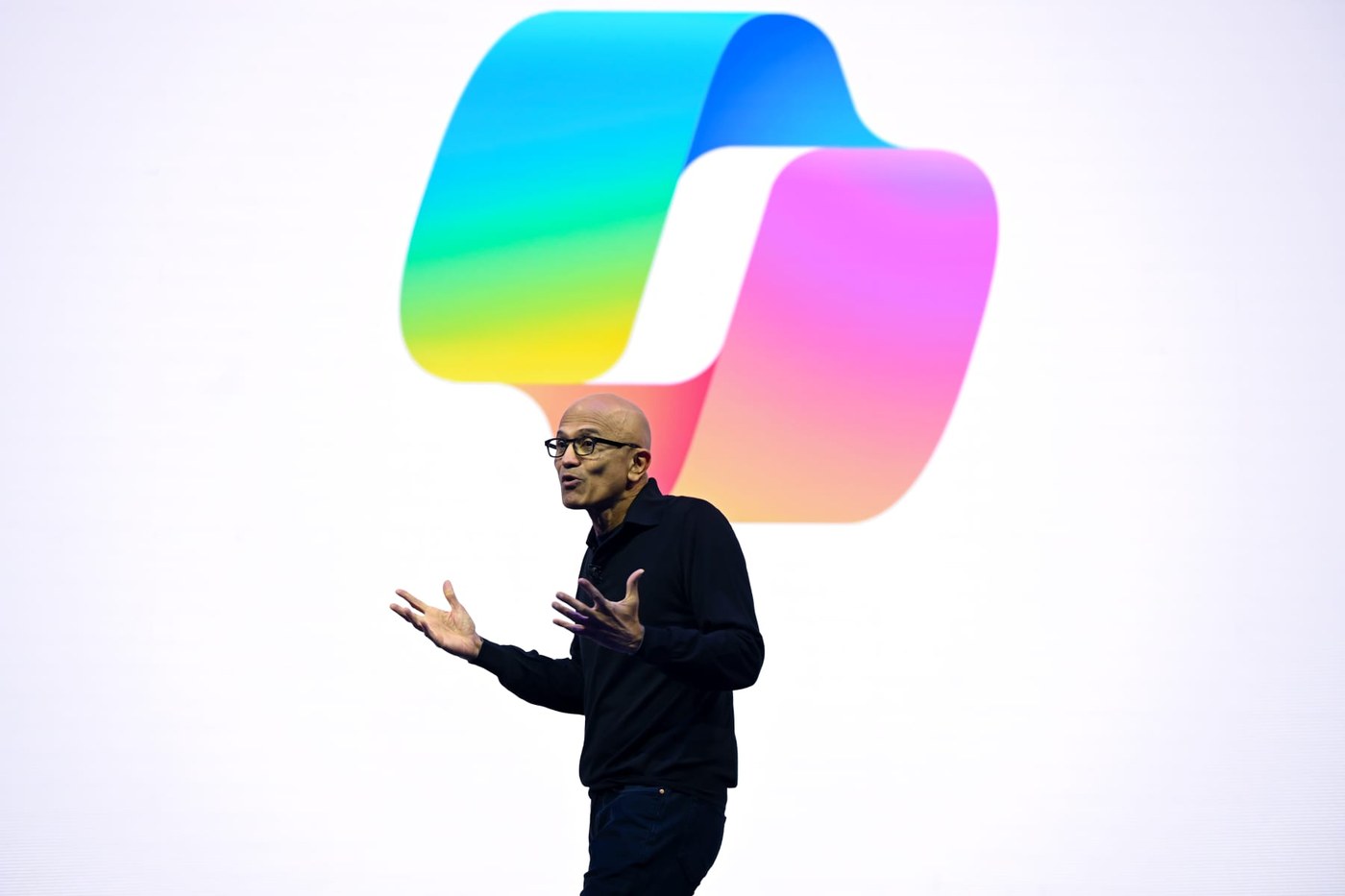
On a sunny day in Seattle in late September, about 50 executives representing large Microsoft customers had a rare opportunity. They could ask anything of CEO Satya Nadella.
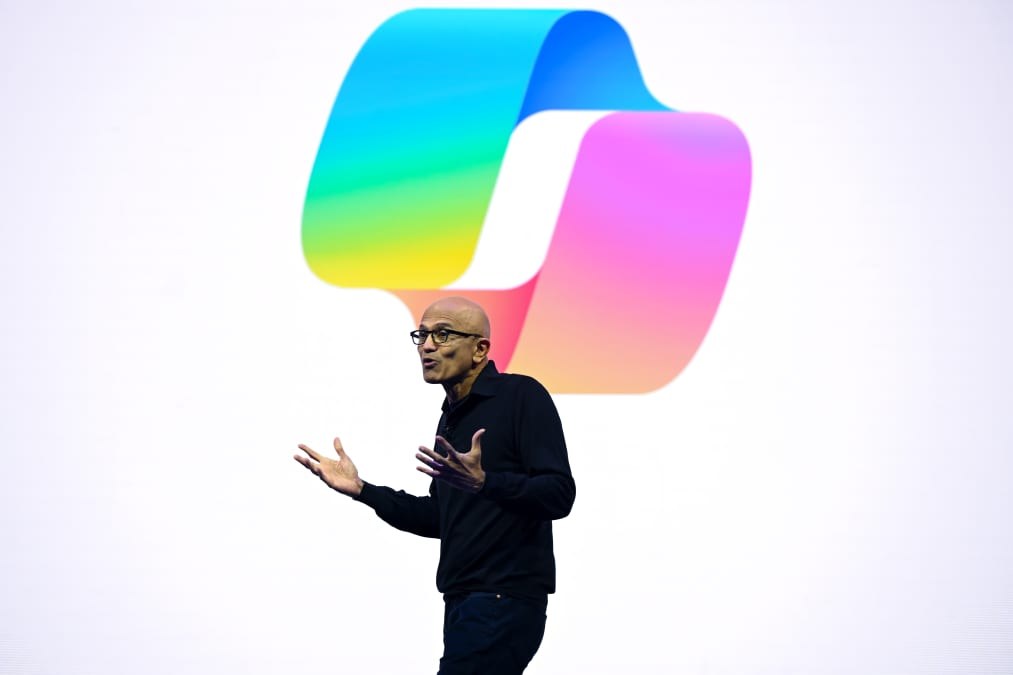
One attendee wanted to know what Microsoft could do to help companies adapt to the artificial intelligence age. Nadella responded by emphasizing the importance of "diffusion inside the enterprise," meaning AI tools need to be widely deployed.
"Like all things, change is always bottom up, top down, and middle up," said Nadella, sporting a tight black crewneck and dark gray slacks, as he strode across the stage at the downtown Paccar Pavilion.
For the 59-year-old Nadella, who's spent over half his life at Microsoft, the gathering landed at a pivotal moment, as the software giant tries to magnify its role in the AI boom. Of late, Nadella has been inserting himself more into the AI discourse, posting on X last month about the need for "deliberate pacing" in model development, and days later addressing safety fears at the All-In Summit in Los Angeles.
Despite its almost $4 trillion market cap, Microsoft has yet to break out as an AI leader. Nvidia dominates in AI chips, Anthropic and OpenAI boast the foremost models, Meta just released the first mass-market personal agent, and Google's Gemini-powered services are popular with businesses and consumers.
Microsoft was aggressively early to AI through an investment in OpenAI, but that alliance has frayed. While the software giant has a big business in renting out chips for AI developers through its Azure cloud, its Copilot technology isn't pervasive in the workplace, and its proprietary AI models remain niche.
The company is hosting a Windows and Surface event in San Francisco on Wednesday, describing it in an invitation as "a conversation on how local AI will shape the next chapter of the PC."
Wall Street is lukewarm on the story. Even factoring in a sharp third-quarter rally, the stock is trailing its megacap peers and the broader Nasdaq this year, up just 7% as of Friday's close. Microsoft hasn't beaten the S&P 500 in a calendar year since 2023.
Tiffany Wade, co-portfolio manager at Microsoft shareholder Columbia Threadneedle, said there are a lot of unknowns about Copilot, which is the centerpiece of Nadella's AI strategy.
"I think there needs to be a little bit more maturity of the product before we figure out actually what the best solution or what pricing is," Wade said in an interview.
For longtime Microsoft investors, Nadella has a solid track record when it comes to navigating industry shifts. He was named CEO in 2014, succeeding Steve Ballmer, who had presided over a roughly 33% drop in the stock price during his 14-year tenure, as Microsoft slipped into the beleaguered category of legacy software.
Nadella proceeded to turn Microsoft into a cloud powerhouse. He tossed aside perpetual Office software licenses and pushed the company into subscription-based software-as-a-service offerings alongside Azure infrastructure. And he permitted customers to integrate products from bitter rivals like Oracle and Salesforce, rather than insisting on a pure Microsoft stack.
Trained as an electrical engineer and computer scientist, Nadella became a savvy dealmaker, expanding Microsoft through acquisitions of "Minecraft"-maker Mojang, business social network LinkedIn and code-sharing service GitHub.
In recent months, Nadella has acknowledged to investors that he's got to change the business model yet again, this time to reflect the AI-fueled move toward consumption-based pricing. That means becoming a vendor of large volumes of tokens, which measure computing usage and represent the currency of the AI economy.
Success would mean "further expanding our TAM," Nadella said on Microsoft's July earnings call, adopting the acronym for total addressable market.
Much of the growth story Nadella preaches involves the production of software. Develop more code and do it faster, boosted by the latest and greatest AI tools.
"We went from the code assist to the agentic coding to software factory all within one year," Nadella said at the customer gathering late last month.
Now he wants to see Microsoft clients open their own software factories, spending more along the way to help churn out code. He's also hoping to empower non-technical knowledge workers. Some of Nadella's lieutenants at the event unveiled a Copilot "super app" that can perform increasingly complex tasks, generate simple applications and function as a virtual teammate.
Nadella had a preview of what was coming.
Microsoft first invested in OpenAI in 2019, when the company was still a fledgling lab. In 2021, a year before ChatGPT launched, Microsoft and OpenAI collaborated to release GitHub Copilot, a tool that could write parts of applications and websites based on vast swaths of public source code.
They'd created an early sensation. But as the generative AI market took off, developers moved to products from AI-native startups like Cursor, now owned by SpaceX, and Anthropic, which rolled out Claude Code.
'Learned lessons'
Microsoft's sluggishness in keeping up with the rapid changes cost GitHub market share.
Earlier this year, Microsoft adjusted the pricing for the coding tool to align more with computing demand. Some customers initially balked, but by July the company said it had racked up 50 million users, up from 26 million last October, meaning that one in five on GitHub were on board.
Nadella said on the July earnings call that GitHub Copilot sales growth accelerated 60% from the previous quarter, with "significant consumption revenue after the new model went into effect."
"GitHub Copilot went out and learned lessons," said Kyle Daigle, the unit's operating chief, in an interview.
Daigle said GitHub employees shared their lessons with other teams at Microsoft that are eyeing consumption-based pricing schemes.
Hayete Gallot, Microsoft's executive vice president for security products, said the company will charge clients according to how intensely they use the technology.
"I always say to my team, when customers consume, it means we add value. And for me, the truth starts with customers," Gallot said. "If they don't consume, it means we're not giving value."
Currently, Microsoft's enterprise portfolio is reliant on subscriptions. For its core Microsoft 365 productivity suite, which includes Word, Excel and Teams, customers sign up for years at a time, and Copilot costs an extra $30 per person each month. Microsoft has 30 million Copilot seats. The commercial Office 365 base exceeds 450 million.
One area of uncertainty in Microsoft's AI roadmap revolves around Mustafa Suleyman.
Suleyman previously co-founded AI lab DeepMind, which Google bought in 2014. Nadella hired him in 2024 to lead AI initiatives as Microsoft's relationship with OpenAI was cooling.
Last year, Microsoft lost its status as OpenAI's exclusive cloud provider, and this year its license on OpenAI intellectual property became non-exclusive. That left the software company with a massive investment in the AI lab but less preferential treatment. Microsoft said in April that it continues to serve as OpenAI's "primary cloud partner."
Suleyman's group has rolled out models for coding, image generation and reasoning. This week he boasted on X that a new speech-to-text model was "the most accurate real time transcription model in the world... #1 !!!" But for raw digital intellect, the team has yet to rival Anthropic or OpenAI, according to independent leaderboards.
Microsoft executives say there are benefits to having model and application development under the same roof. The group building Teams and other Office productivity apps has seen higher performance from Suleyman's transcription models at a lower price, and engineers get clear feedback as they build out products, said Executive Vice President Charles Lamanna.
"The collaboration is much tighter with Mustafa," he said.
Suleyman maintains a high profile at Microsoft, but his responsibilities have shifted. In March, Microsoft announced that it was bringing together the engineering groups for its commercial and consumer Copilot assistants, as adoption had been sluggish. Jacob Andreou was promoted to executive vice president for Copilot experience, and Suleyman was charged with focusing on model development.
Nadella, meanwhile, has been downplaying the importance of world-beating models in isolation.
"In my view, our priority has to be building a frontier ecosystem, not just a frontier model, so value flows broadly across every company, every industry, and every country," he wrote in a post on his SN Scratchpad website in June.
At the September Copilot event, Nadella stood before a slide declaring that Copilot could connect to "every model," with the Anthropic, OpenAI, SpaceX and Microsoft AI logos.
Fixing the economics
Increasingly, Microsoft is finding the model leaders encroaching on its turf, as they release products for cybersecurity, customer service and other functions.
In January, as Anthropic's Claude Code was building momentum, Microsoft executives were impressed with its ability to tap a bevy of tools to get things done, said Jared Spataro, Microsoft's marketing chief for AI at work. Microsoft was losing deals to Anthropic, promoting a close study of a rising competitor, said a person familiar with the matter, who asked not to be named due to confidentiality.
A Microsoft spokesperson declined to comment.
Spataro said the company sensed a need to change the mechanics.
"It became very clear to us at that moment. Like, oh wow, the economics are not going to be such that we're going to be able to offer now the best outcome within a fixed price per user per month," Spataro said. "We realized that we needed to start to think about the business model."
The company got cracking on a more comprehensive approach to consumption-based pricing that it calls usage-based billing, or UBB. The first UBB product was Copilot Cowork, which accepts large productivity assignments and shows its progress, Spataro said.
Nadella said on the July earnings call that "earlier this month, we added usage-based billing to Cowork with thousands of customers already paying for and actively using it."
Derrick Wood, an analyst at Cowen, said it was a strong signal.
"It may have the effect of what we saw when Claude Code, for example, shifted to consumption pricing, and you saw token bills go significantly higher," said Wood, who recommends buying Microsoft shares. "There's definitely the possibility for that to happen with Cowork."
Nadella is a user. On a podcast recorded after the September event, he said he can ask Cowork to prepare a supply chain optimization spreadsheet showing multiple scenarios.
"It'll create a fantastic artifact," he said.
David Berry, a vice president at advisory group Directions on Microsoft, said budget-conscious IT executives aren't all ready to take the Cowork plunge.
"There's a very real concern that you just kind of turn it on and people are going to start draining the bank," Berry said. "There's no way to determine if people are actually getting any benefit from it."
With the ChatGPT era nearing its four-year anniversary, Microsoft is still looking for a smash hit, whether at the model or application layer. While Nadella earned investor trust in reviving Microsoft once, he can't afford to let the company become an also-ran in AI.
Berry said he still sees Nadella as the right person to command the ship.
"He seems to be able to handle the situations or identify the situations and come up with a plan to change and evolve the business," he said. "The challenge is we're facing a lot more of the unknowns in a sense with AI, so it's a lot of different market dynamics going on, but he seems to have a plan, and he's working the plan."
In Seattle, Nadella ended his response to the transformation question by saying that those at the top of organizations play a key role.
"Leaders who are hands-on are able to change," he said. "Otherwise, they're all from press event to press event, right?"
He added, "It's kind of like you've got to be in it."
WATCH: BofA's Liani on Microsoft upgrade: Investors are underestimating how it is differentiating in AI