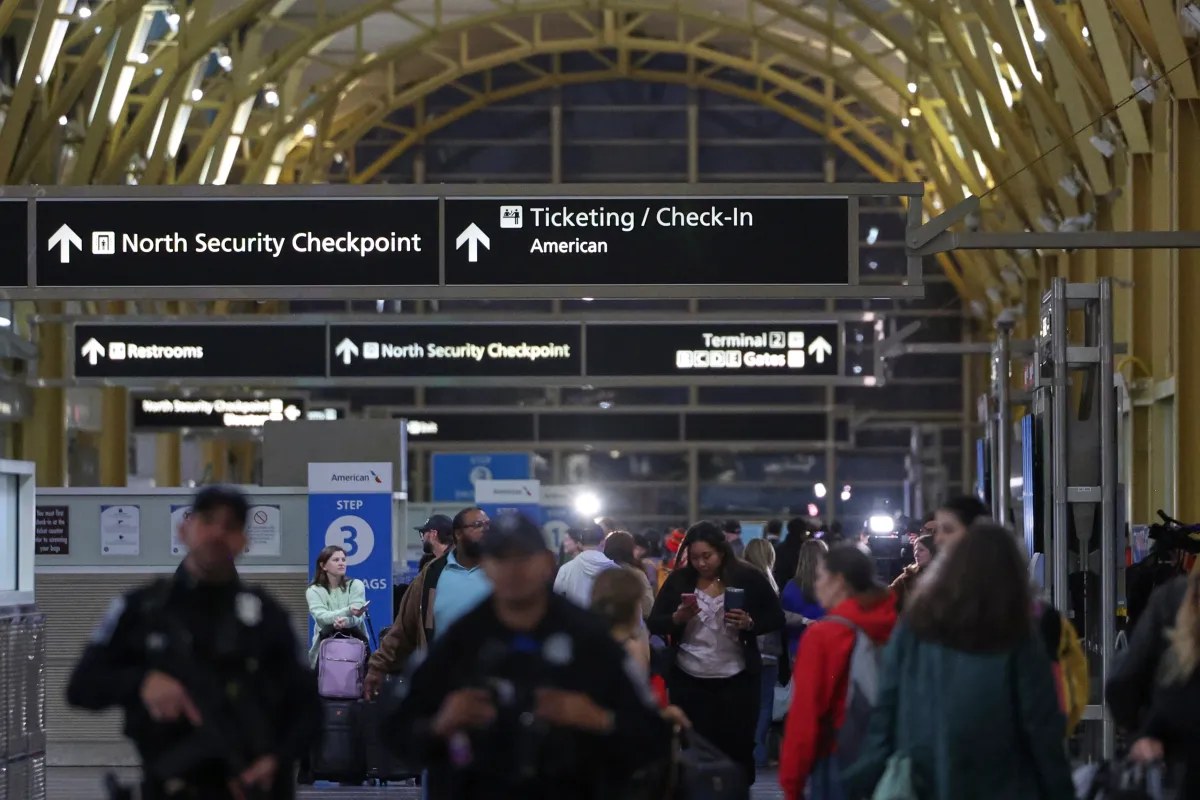
An unprecedented telecommunications failure triggered a nationwide ground stop for about four hours Friday, stranding an estimated 1.5 million travelers across the United States and resulting in 9,814 flight delays and 5,117 cancellations.
Travelers scrambled for hotels, rental cars and attempted to rebook flights as aviation experts warned that Friday was poised to become the biggest disruption to travel since 9/11 after the Federal Aviation Administration (FAA) ordered all departing aircraft to remain on the ground following communications problems affecting air traffic control centers.
The airspace was reopened at 8:45 p.m., but officials warned it would take days to clear the backlog. Trump administration officials say the shutdown shows the country must update its aging, overloaded infrastructure.
Read More on News
"This is a national security risk," Markwayne Mullin, U.S. Secretary of Homeland Security, said late Friday.
The FAA said it had issued the order after communication issues impacted multiple Air Route Traffic Control Centers, with technicians investigating the problem.
"All departing traffic should remain ground stopped until further notice. Inbound international flights will be managed on a case by case basis," the FAA said in an advisory.
Ken Gray, former pilot and intelligence officer, and now a professor at the University of New Haven, compared the fallout of the ground stop to that of the 9/11 terror attacks.
"When 9/11 happened ... they did an incredible job getting planes down on the ground. They emptied the airspace out within two hours and got all the aircraft that were in the air on the ground," he said. "But once they got it all on the ground, it took several days for it to be safe to allow the aircraft back up.
"Likewise, once they get everything back on the ground, even if everything is working again, it is going to take some time to get the aircraft back in towards their destinations because everything is out of sync as far as flights go."
He added that Friday was set to be the most disruptive travel day since the attacks, with the delays and cancellations expected to last through the weekend.
Steven Marks, Managing Partner of Podhurst Orseck, a leading aviation disaster litigation firm, said today's ground stop would spark "chaos."
"It is travel chaos because tomorrow many of these aircraft are going to be sitting at airports," he told Newsweek. "But they were not intended to land. So you're going to have problems with gates. You have problems with planes not even being able to find gates in certain airports."
"So it's going to be everybody can be working all through the night to try and minimize the disruption, but it's going to occur."
He also compared the chaos to 9/11, but he said in that case planes across the U.S. were grounded in the wake of the terror attacks. Now it appears to be a system failure.
Marks also said that the U.S. was supposed to have the most "sophisticated aviation system in the world." A nationwide ground stop indicated a major issue.
"It's embarrassing, and it's dangerous, and it should never have happened," he said. "It should not have happened. It presents a dangerous situation to the flying public. Not the disruption, but the safety of people's lives."
"I suspect we'll get through the next 24 hours without any incidents, and hopefully that won't be the case. But it's a mess and it will be a mess for a few days," he continued, adding there was likely to be "worldwide disruptions."
In a statement to Newsweek, the FAA said: "The FAA issued a nationwide ground stop for all U.S. airports following communication issues impacting multiple Air Route Traffic Control Centers. FAA technicians are investigating the issue. We will provide updates."
The agency stressed that the information was preliminary and subject to change.
The disruption has prompted airports to warn passengers to check with their airlines before traveling, while a former senior FAA official said the nationwide nature of the order was unusual.
FBI officials referred inquiries by Newsweek to the Department of Homeland Security, which did not immediately return requests for comment late Friday.
What Are Airports Telling Passengers?
John Glenn Columbus International Airport has warned passengers departing from both Columbus and Rickenbacker International Airport to check their flight status before heading to the airport.
In a post on X, the airport said: "The FAA has issued a nationwide ground stop until further notice. If you're flying out of John Glenn Columbus International Airport (CMH) or Rickenbacker International Airport (LCK), please check with your airline for the latest flight information before heading to the airport."
Ronald Reagan Washington National Airport also warned passengers to expect delays.
"ALERT: Expect flight delays related to a nationwide ground stop reported by the Federal Aviation Administration. Our airport facilities are open. Check with your airline regarding the status of your flight," the airport said.
Passengers are being advised to contact their airlines directly for information about individual flights, as the ground stop does not necessarily mean airport terminals are closed.
The FAA has also said that international arrivals will be handled on a case-by-case basis.
Travelers should monitor airline apps and airport announcements for updates, and check whether their flights have been canceled or rescheduled before setting off.
Airlines are also urging customers to monitor their flight status in the coming days.
Delta Airlines told Newsweek that it had no flights departing currently, although flights enroute would continue to their destinations.
"Safety remains our priority which includes flights already enroute and those we intend to dispatch tonight. Customers should monitor their flight status on the Delta app or delta.com for the latest information," the spokesperson said.
"Our goal is to safely resume departures when possible. We thank our customers for their understanding and our people for managing through the issue."
Meanwhile, Gray suggested anyone stuck waiting for a flight home should consider booking a hotel.
"I would not be surprised if it takes at least a day to be able to get back, or two days to get back into full functioning. People who are stranded somewhere, they'd better be looking for a hotel," he said.
Why Has the FAA Grounded Flights?
The FAA initially described the circumstances as "extraordinary" and cited safety reasons for the nationwide order.
It subsequently confirmed that communications problems affecting multiple Air Route Traffic Control Centers had prompted the decision.
Transportation Secretary Sean Duffy confirmed the issue in a post on X. "The @FAAnews issued a nationwide ground stop for all U.S. airports following a communication issue impacting all Air Route Traffic Control Centers. FAA technicians are investigating the issue. We will provide immediate updates as we have them," he wrote.
The Pentagon referred Newsweek to the FAA when asked for comment.
Marc Nichols, who served as FAA chief counsel under former President Joe Biden, told Newsweek that while ground stops were not atypical, nationwide orders were less common.
"Ground stops are not unusual. Nationwide ground stops are a little more unusual," Nichols said. He explained that such measures could be implemented for several reasons, including anticipated weather, security concerns or system malfunctions. "At this stage, we should not speculate as to the cause," he said.
Nichols added that the transportation secretary's statement suggested an air traffic control communications issue. "The FAA's primary concern is safety of passengers, and it will share more details with the public when appropriate," he said.
Gray cited America's aging aviation system as a potential cause for the ground stop.
"Our country has what is called critical infrastructure, those systems that if something were to happen to it, it makes it very difficult to continue on with day-to-day business. Well, communications is one such critical infrastructure, and that includes communications between systems like air traffic controllers," he told Newsweek.
"The FAA is operating on old technology. So, if they have not updated their communication system, it's probably overdue."
How Long Could Flight Disruption Last?
It remains unclear how long the nationwide ground stop will remain in effect or how quickly normal flight operations can resume.
Even after the FAA resolves the communications problem and allows departures to restart, passengers could continue to experience disruption as airlines work through delayed flights and operational backlogs.
Aircraft and crew schedules are closely interconnected. When flights are held on the ground, aircraft can arrive late at their next destinations, while pilots and cabin crew may be unable to reach their subsequent assignments on time.
This can create a knock-on effect across airline networks, potentially resulting in further delays and cancellations even after the original technical problem has been resolved.
The extent of any continuing disruption will depend on how long the ground stop remains in place, how many flights are affected and how quickly airlines can restore their schedules.
Nichols said the FAA would provide further information when appropriate, but no confirmed timeline for a return to normal operations had been announced.
Passengers with flights scheduled for Friday evening and over the weekend should continue checking directly with their airlines for the latest information.
Newsweek’s reporters and editors used Martyn, our AI assistant, to produce this story. Learn more about Martyn here. Contact Newsweek editors on this story: Samantha Beech and Edward T. Cummins